RESEARCH ALERT
Some vapes use added chemicals to create a cold or icy feeling. New research has raised concerns about three of them: WS-23, WS-3 and WS-5. We do not yet know how common they are in Wales.

Information / Smoking in the home
Making your home smoke-free
You do not have to wait until everyone has quit smoking to make the home safer. The rule that works is simple: smoking happens outside, every time.
Last reviewed: 30th September 2026
WHAT DOESN’T WORK?
A window, fan or closed door is not enough.
Smoke spreads between rooms and can remain in the air after the cigarette is out. Ventilation does not turn indoor smoking into a safe option.
A smoke-free home in four practical steps
Make the rule easy to understand and easy to repeat.
1
Smoke fully outside
Not by an open door or window. Move away from the building so smoke is less likely to drift back inside.
2
Keep the car smoke-free
Do not smoke in the car, even with the windows open. Smoking in a private vehicle carrying someone under 18 is against the law.
3
Use the same rule for visitors
A smoke-free home works best when family, friends and visitors know the rule applies to everyone.
4
Make the outside option easy
Keep a coat, shoes or an ashtray by the exit if that removes friction. Small practical changes make the boundary easier to stick to.
Why this matters more around children
Children’s lungs, airways and immune systems are still developing. Second-hand smoke is linked with asthma, chest infections, ear infections and other illness.
A smoke-free home also means children see smoking less often as part of everyday family life.
Pregnant or have a new baby at home?
Keeping the home smoke-free matters during pregnancy and after birth. If the pregnant person or someone else in the household smokes, free support is available.
If smoke is coming into your home from somewhere else
If smoke is drifting into your home from another flat, shared area or neighbouring property, the route depends on where it is coming from.
Shared areas in blocks of flats: communal lifts, stairways and other shared parts of a dwelling are required to be smoke-free in Wales. If smoking is happening there, report it to the landlord, housing association or building manager.
Smoke from another private home: private dwellings are generally not covered by Wales’s smoke-free law. If smoke is repeatedly entering your home, keep a simple record of when it happens and where it seems to enter. If you rent, report it in writing to your landlord or housing association and ask whether shared ventilation, gaps, ducts or other building routes can be checked. Avoid blocking required ventilation yourself.
If the problem is persistent or affecting health: your local council’s environmental health team can advise. Under the Environmental Protection Act 1990, councils in Wales must take reasonably practicable steps to investigate complaints about potential statutory nuisance. Whether tobacco smoke reaches that legal threshold depends on the circumstances, so not every complaint will lead to formal action.
Our 2026 social-housing report also includes new survey findings on smoking inside the home among social-housing respondents.
What about smoke on clothes and surfaces?
Tobacco smoke leaves chemicals on clothes, hair, furnishings and surfaces after the cigarette has gone out. This is sometimes described as third-hand smoke.
Smoking outside is still the most useful immediate step if someone is not ready to quit. Washing hands and avoiding smoking immediately beside babies or children can reduce additional exposure, but these steps do not make indoor smoking safe.
Not ready to quit yet?
Making the home smoke-free is still worth doing. It can be a separate decision from quitting cigarettes completely.
When you are ready to think about quitting, you can start with a conversation rather than a commitment.
Want the home to stay smoke-free without going outside for cigarettes?
Help Me Quit offers free NHS support, quit aids and practical help across Wales. You do not need a GP referral.
NEW RESEARCH • 2026
What our 2026 social-housing research found about smoking at home
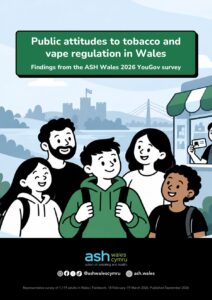
In the ASH Wales/YouGov 2026 survey, 23% of adults living in social housing said someone smoked in the home most days, compared with 8% of homeowners. The survey does not tell us whether children were present when someone smoked. Read the full 2026 survey.
LATEST
Latest updates on this topic
2 October 2026
New Welsh report highlights confusion over vaping harms as duty begins
More than half of Welsh adults who have heard of vapes wrongly believe vaping is as harmful as smoking or worse, new ASH Wales…
Read update1 October 2026
New vaping duty comes into force across Wales today
A new UK excise duty on vaping products starts today, 1 October 2026. Here is what the £2.20 per 10ml duty, new vape duty…
Read update25 September 2026
Youth smoking and vaping in Wales: what the latest 2025 data tells us
New 2025 SHRN data shows regular vaping and smoking have fallen among secondary school learners in Wales. We look at the latest figures, what…
Read update