
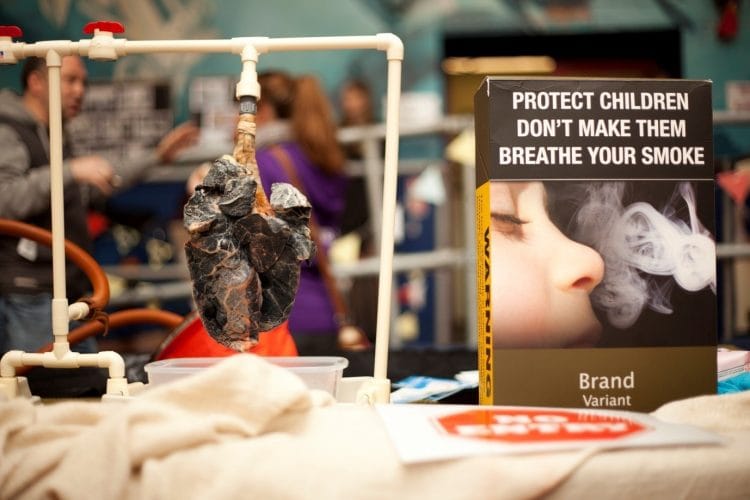

Wales Makes History By Banning Smoking In School Grounds, Hospitals and Playgrounds

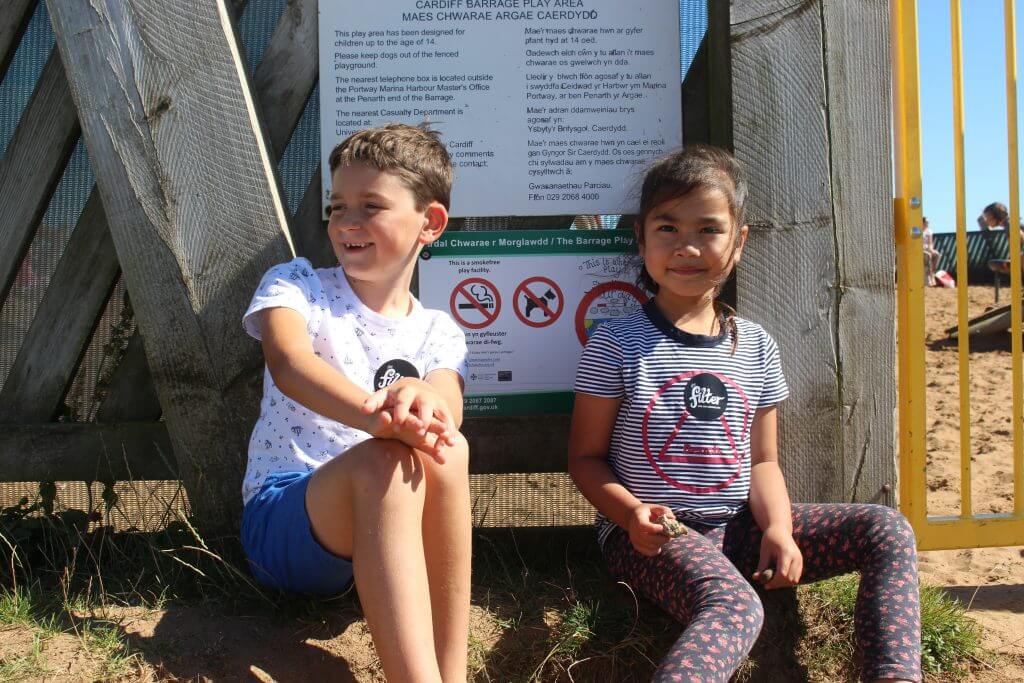
Wales makes history today by becoming the first country in the UK to ban smoking in the grounds of schools and hospitals and in children’s playgrounds.

The Public Health (Wales) Act legislation which comes into force today, is aimed at driving down smoking rates in Wales where 18% of the adult population currently smoke. Any smokers caught lighting up in areas covered by the act could be subjected to a £100 fine.

When the legislation was first announced it was hailed by Welsh Government ministers as the most important public health legislation to be launched in a decade.

Smoking is the biggest cause of early preventable death in Wales and it costs the Welsh NHS £320 million a year to treat patients with smoking-related conditions.  Meanwhile smoking prevalence among young people remains stubbornly high with around 8% of 15–16-year-olds smoking weekly and an estimated 6,000 children taking up the habit every year. According to a YouGov survey by ASH Wales, 81% of adult smokers  tried their first cigarette aged 18 or under.

ASH Wales, which campaigned for the Public Health (Wales) Act legislation to come into force, believes the legislation will help to de-normalise smoking, prevent young people from taking up the habit and encourage existing smokers to quit. The charity also hopes the legislation could pave the way for more smoke-free spaces, with ministers indicating that a ban on smoking outside pubs, cafes and restaurants could be considered in the future.

Suzanne Cass, CEO of ASH Wales, said:

“We are very proud that Wales is leading the way with this forward-thinking legislation.

“For too long smoking has been perceived as a normal lifestyle choice with smokers being able to light up in places where our children play, socialise and learn.

There is nothing normal about smoking, however. It is an extremely harmful addiction that all too often begins in childhood.  We hope that this legislation will make great strides in changing perceptions about this addiction and prevent children from becoming the next generation of adult smokers.”

Have your say on the future of stop smoking support in Wales

Would you like to have your say on the future of stop smoking support in Wales?  ASH Wales is giving you the opportunity to help shape the future of quit smoking support and by taking part, you could win £200.

There is free support available for all smokers in Wales from Help Me Quit and you can also access free NRT and behavioural support from your local pharmacy. But what’s currently missing is an online system that could help smokers to book stop smoking appointments, access helpful tips and track their progress.

To find out if this type of digital solution would work, we need to hear from smokers and ex-smokers which is why we’re inviting you to take part in our survey.

Nobody knows more about smoking and the challenges of quitting than smokers and ex-smokers and we’d really value your opinions. We know quitting smoking can be tough and we want to find the best way to reach out to smokers and provide them with the support they need.

It only takes a few minutes to answer our questions and everybody who takes part will be entered into a prize draw with the chance of winning £200. To take part just click here

Pembroke Secondary School Stubs Out Smoking At The School Gates

A secondary school in Pembrokeshire has become the latest to ban people from smoking outside its school gates.

Henry Tudor School in Pembroke has made the move ahead of new laws due to come into force in March across Wales, banning smoking in all school playgrounds.

The ban on smoking outside the school gates is aimed at tackling youth smoking prevalence by de-normalising smoking and reducing children’s exposure to second hand smoke. It comes ahead of the Public Health Wales Act legislation which comes into force on March 1st and will see smoking banned in the grounds of school and hospital grounds and in children’s playgrounds across Wales.

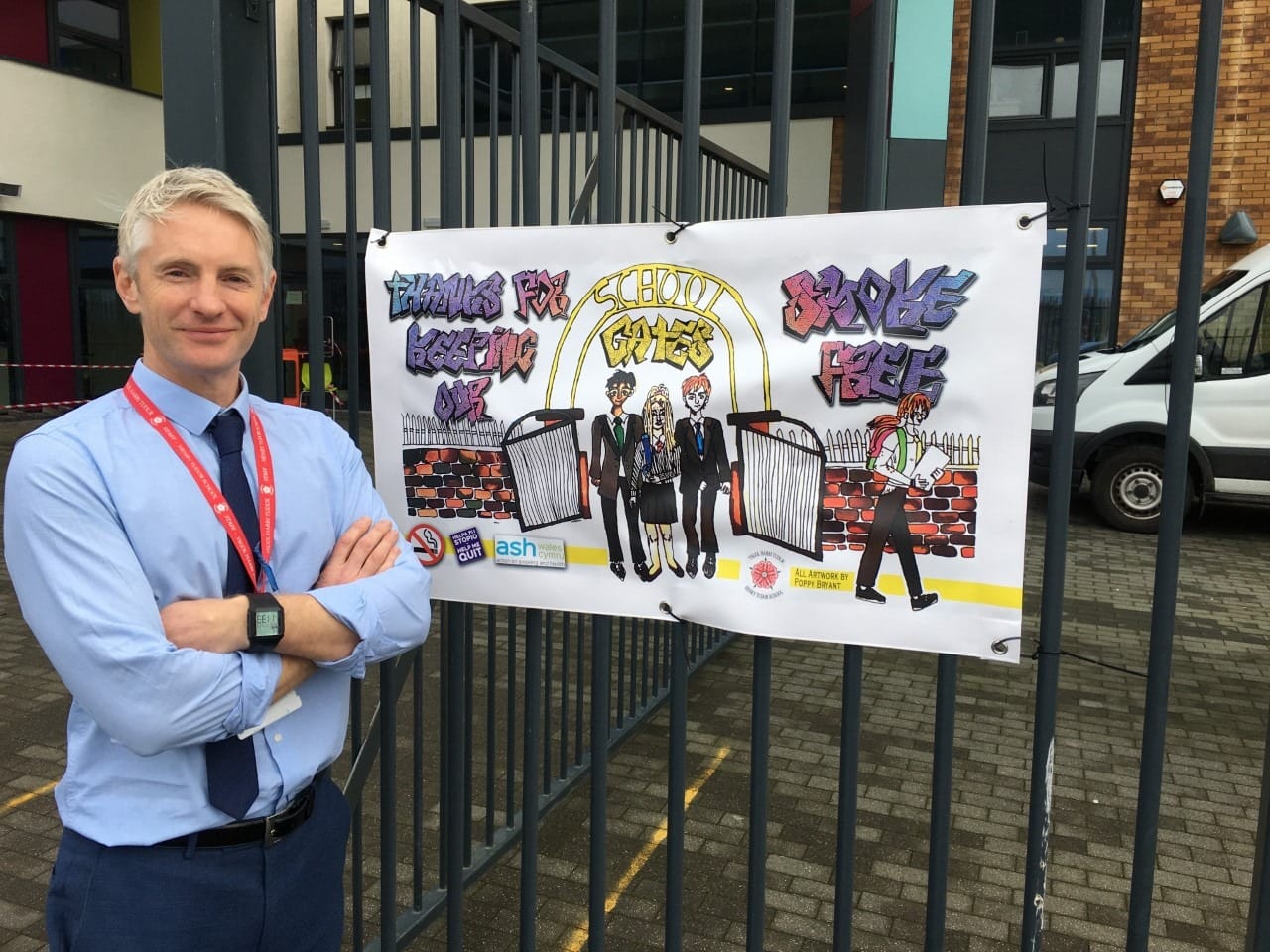
Visitors to Henry Tudor School will now be greeted at the school gates by a banner asking them not to smoke which was designed by one of the pupils.  Schools across Wales are now expected to implement Smokefree Schoolgates with help from ASH Wales which is providing them with banners, floor stickers and social media support.

The Smokefree Schoolgates campaign was originally launched by ASH Wales in 2015 and more schools are now coming on board due to the new legislation.

Deputy Headteacher Andrew Barlow explained why the school had adopted the policy:

“Our main aim is to stop parents who pick up their children from smoking in front of other pupils and to stop older pupils from smoking as they leave the school

“So far we’ve had a really positive reaction from both staff and pupils particularly those who have been involved in the design of the stop smoking banner. The school council are also happy because this was something they’d campaigned for.

“We very much hope this will result in a decline in pupils lighting up as they leave school and we feel it’s crucially important to de-normalise smoking in the eyes of young people and change parents’ attitudes towards smoking in front of children.”

Currently in Wales 8% of 15 to 16-year-olds smoke at least weekly. ASH Wales is campaigning for all schools across Wales to ban smoking at the school gates. Suzanne Cass, CEO of ASH Wales said:

“Youth smoking prevalence in Wales remains stubbornly high with  thousands of children continuing to take up the habit every year, despite concerted efforts to teach them about the dangers.

“Smoking is not a lifestyle choice, it is a lifelong addiction, with devastating consequences, that all too often starts in childhood.

“We believe that one of the most effective ways to tackle this problem is reduce children’s exposure to the sight of adults smoking in everyday situations such as standing by the school gates.

“We are really pleased that Henry Tudor has joined the many schools in Wales in making the forward-thinking decision to introduce smoke-free school gates and we hope that others will follow suit.”

ASH Wales carried out a survey of pupils at Henry Tudor School to find more about their exposure to smoking.

Of those that took part, 28% said that somebody in their home smoked daily. Meanwhile among pupils that smoked themselves, 22% said they would like to quit the habit.

Research has shown that children are over 70% more likely to smoke themselves if just one of their parents smoke.

Smokefree Action Coalition Calls for Decision over Standard Packs for Tobacco

Over 78,500 children have started smoking since UK Government’s consultation on standardised tobacco packaging ended

This Valentine’s day the Smokefree Action Coalition is calling on the UK Government to take action and “have a heart” by committing to legislation to make all tobacco packaging standard. Today is the tenth anniversary of the implementation of the ban on tobacco advertising and the seventh anniversary of the Commons vote for smokefree legislation.

The clock is ticking. Since the consultation on the legislation ended just over six months ago, it is estimated that 78,500 children will have started smoking in the UK, a number which grows by 430 every day. Now the Smokefree Action Coalition, an alliance of over 190 health organisations including ASH Wales, the BMA, medical royal colleges, public health bodies, academic institutions and health charities are calling on the Government to publish the results of its consultation and announce that it will go ahead with legislation.

Currently in the UK, there are no restrictions on the way tobacco multinationals are allowed to promote their brands through packaging. The packs are now the principal form of tobacco promotion and are designed to attract existing and potential consumers with colourful and eye-catching imagery.

Elen de Lacy, Chief Executive of ASH Wales, said:

“It’s time to make attractive tobacco packaging history and to introduce standard packs in the UK. No more pink and shiny packaging or tobacco packs that look like perfume boxes. No more slim-line cigarettes with ‘Vogue’ on the cover which are targeted directly at teenage girls. Smoking kills and we must take away the tobacco industry’s last form of advertising to our children.”

Sir Richard Thompson, president of the Royal College of Physicians, said:

“As a young doctor I was depressed to see so many patients in their 50s and 60s suffering because they had started smoking as children. Back then there was very little we could do, but now we have the opportunity to help protect our children by implementing standardised packaging.”

Smoking is a childhood addiction, not an adult choice. More than 150,000 children start smoking each year in the UK. Half of all lifelong smokers will die from their addiction, amounting to over 100,000 people last year in the UK.

Putting tobacco products in standardised packs is a popular measure. Opinion research shows that 62% of the public support the plain, standardised packaging of tobacco products, with more smokers supporting than opposing the measure. Over 200,000 people have expressed their support for the introduction of plain, standardised packaging of tobacco products in the UK. Internationally, standardised packaging is already in place in Australia which became the first country to implement such legislation in December 2012.

It’s time for the UK to follow suit.

A day in a life of a hospital smoke-free enforcement officer

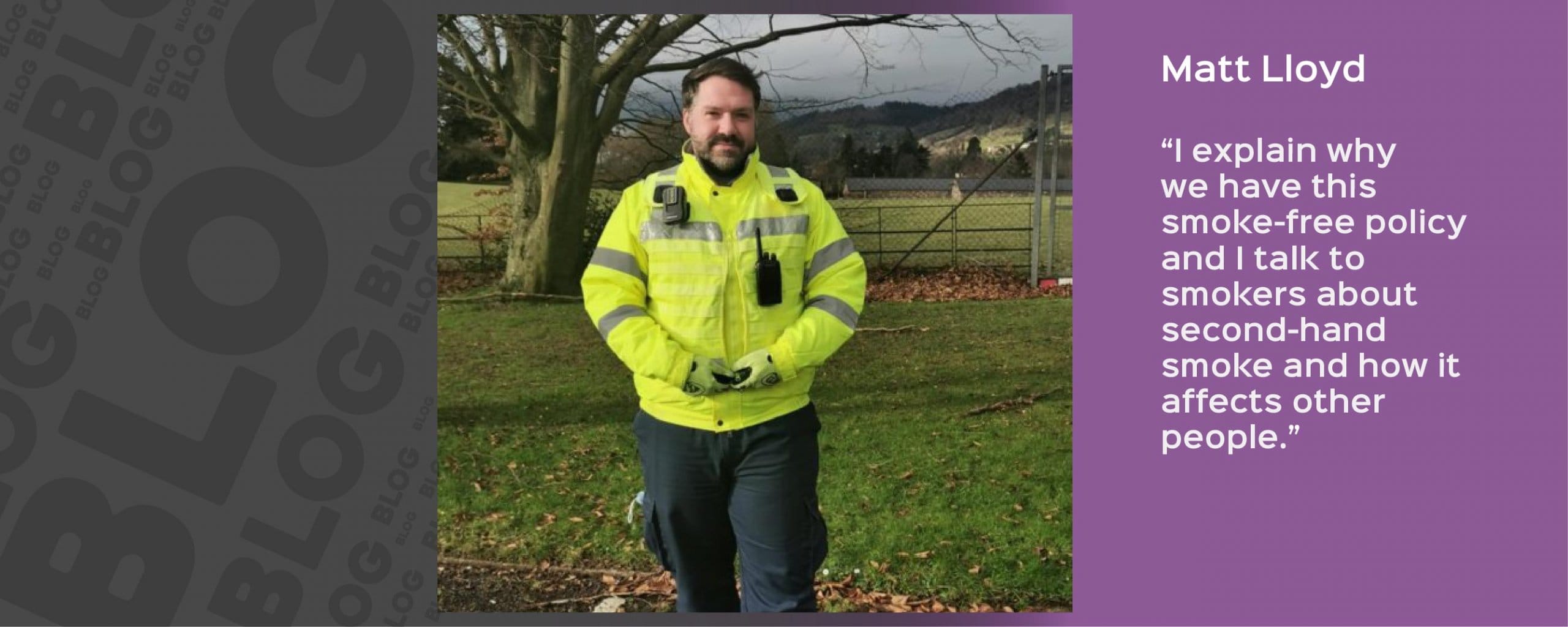
If you light up a cigarette in the grounds of Nevill Hall or the Grange University Hospital, you will probably end up having a chat with one of Aneurin Bevan University Health Board’s Smoke-Free Enforcement Officers, Matt Lloyd. His job is to patrol the hospital grounds, speak with smokers and ask them to stub out their cigarettes or move outside the hospital grounds. When the Public Health (Wales) Act comes into force on 1st March 2021, he will be reminding people that it is illegal to smoke on hospital grounds and they could be faced with an on the spot fine of £100. We caught up with Matt to find out more about his job and why he is on a mission to help smokers to quit.

“]I love my job and it really keeps me on my feet. No day is the same and I never know what reaction I’m going to get from smokers when I approach them.

There are lots of different places where staff, patients and visitors can tuck themselves away for a smoke on the hospital grounds and dealing with that is a constant battle.

The smoke gets through the vents of the hospital windows and it can have a damaging effect on patients. A hospital is a place where people come to get better

and patients suffering from asthma and heart conditions really should not have to be exposed to other people’s smoke. There are also lots of ex-smokers coming in. Walking into the hospital through a cloud of smoke could be the trigger that gets them smoking again.

Dealing with the daily situation is very challenging, particularly at the moment. Because of the Covid-19 pandemic, visitors can’t go into the hospital, so they drop their relative outside and have a smoke while they wait. Meanwhile, staff are under immense pressure, some of them go outside for a break and take the opportunity to have a cigarette. If they are willing to have a chat, I will discuss other options for stress relief and remind them that breaking the policy is a disciplinary offence.

People come to the hospital with serious medical problems and visitors can be pretty stressed and emotional. I make a point of always approaching people with a smile and trying to be as helpful as I can. I explain why we have this smoke-free policy and I talk to them about second-hand smoke and how it affects other people. About 90% of people do move on and I always try to leave them with a smile as well.

If somebody refuses to stop smoking, I talk to them again about why we have the policy and the law that is soon to be introduced. If it’s a patient I can contact their ward manager who can offer them Nicotine Replacement Therapy to help with cravings. It is everybody’s responsibility to support the smoke-free policy and up-coming law to make sure we offer our staff, patients and visitors a positive experience when using our NHS services.

quitting smoking covid-19

When I approach someone who is smoking, it’s a great opportunity for me to encourage them to quit smoking by contacting Help Me Quit or taking up the help that’s available within the hospital including free nicotine replacement therapy. I always hand out Help Me Quit leaflets and regularly set up a stall in the hospital lobby with information about quitting for those who want to take the opportunity.

The new law coming into force on March 1st will mean that we can hand out £100 fines. That’s a steep penalty and I think it will encourage people to respect the rules a lot more. There will of course be people who don’t comply but I’m hoping it will encourage more people to think about where they smoke and how it is affecting others.

The Health Board is also installing loudspeakers at the main entrances to both hospitals, that alert smokers that they shouldn’t be smoking here. Anybody can press the button if they see a smoker, which will be a big help in keeping the hospital smoke-free and will give people the confidence to challenge smokers.

I really enjoy the challenges this job brings and that fact that no day is the same. You never know what reaction you’re going to get from person to person. It keeps me on my feet. I don’t just talk to people about smoking, I’ve had patients telling me their life stories and supported staff in times of stress.

Even though I’m there to enforce the policy, I want to be a friendly face so that people feel they can come to me for advice and if they do want to quit, I can offer information about where they can get professional help.

How I Beat 46 Years of Addiction and Quit Smoking

Susanne, from Cwmbran, quit smoking on 5 December 2020, after 46 years of addiction. She started smoking at just 15 years old and had tried to quit many times before. This time, something changed.

What inspired you to quit smoking?

A few months earlier, my grandson asked me why I smoked. I couldn’t really give him an answer, only that I was addicted. He asked if I was bothered that it’s bad for you and can kill you.

He said, “I am worried Granny that you won’t be here long enough to see me grow.”

That shook me. I hadn’t long lost my mum and was still grieving. Every time I lit a cigarette after that, I thought about what my grandson had said. I knew I had to do it for him and my other grandchildren.

What impact was smoking having on your life?

I’d suffered with very high blood pressure for years and taken lots of different medications that didn’t seem to work. The next step would have been beta blockers, likely for life. Then there was the breathlessness. I was finding it harder and harder to do everyday things, even just walking up the stairs.

Financially, I couldn’t afford to smoke, yet I always found the money somehow. If I thought I wouldn’t be able to buy cigarettes, I would panic. I even had the odd panic attack. I’d lie awake worrying in case I didn’t have enough to last until I could get to the shops. It was taking a serious toll on my mental wellbeing.

Did you get any help to quit?

I started by searching online for support and looking into what help was available locally. During the pandemic, face to face services were limited, so I was relieved to find the NHS Help Me Quit service.

I filled in my details and received a call back within 48 hours.

I was given a personal adviser, Vicky. We talked through my smoking habits and what nicotine replacement products would work best for me. She arranged everything over the phone and sent a prescription so I could collect what I needed from the chemist free of charge. Vicky continues to check in regularly, and I can contact her if I ever need extra support or advice about the products.

How did you find the experience of quitting?

After many failed attempts over the years, I really tried to prepare mentally this time. I kept going over my reasons for stopping in my head.

I smoked my last cigarette, put on a 21mg patch, and haven’t looked back. Being in the right mindset, reminding myself why I was quitting, and knowing someone would be checking in with me made a huge difference. Using nicotine replacement therapy meant I experienced very few withdrawal symptoms. It was much easier than I expected.

How has quitting smoking improved your life?

My health has improved so much. I can walk up the stairs without getting breathless. My sense of taste and smell are stronger. I sleep better and no longer have panic attacks linked to cigarettes or worrying about running out.

Most importantly, my grandson is so proud of me. That means everything. The money I’ve saved will go towards my grandchildren, with something extra special for the grandson who gave me the push I needed.

What advice would you give to any smokers out there who would want to quit but think they can’t do it? 

I would say try, try, and keep trying as at some point you will do it. My grandson was my motivation, find something that makes you determined to stop. Keep thinking of it for a few days before you actually stop.

I’d also definitely get in touch with the NHS FREE service, get your own advisor who will get you the right NRT products and have these to hand as soon as you have smoked that last cigarette.

Just go for it… I am almost 6 weeks smoke free and feel so much better for it. Be proud of yourself for everyday you are smoke free and with each day remember you are repairing your body from all the harmful chemicals you used to inhale.

Go for it! Be proud of yourself…..You can do it!