


COPD and smoking – an expert’s guide

Every year thousands of people in Wales are diagnosed with chronic obstructive pulmonary disease (COPD) – a group of lung conditions that cause breathing difficulties.

The main cause of the condition is smoking and, according to the NHS, quitting smoking is the best way for sufferers to relieve their symptoms and slow down the progression of the condition.

To  mark COPD Awareness Day we met Professor Keir Lewis, Professor of Respiratory Medicine, Swansea University and
Consultant at Hywel Dda Health Board to find out more about the condition, how it affects people’s lives and its link to smoking.

How prevalent is COPD in Wales?

We believe it affects around 2 to 5% of the population. Around 74,000 to 80,000 people have been diagnosed with COPD in Wales – that’s about the equivalent of a whole Millennium Stadium’s worth of people. Around 3,000 people are diagnosed with COPD every year in Wales. However, we think that in reality, there are probably twice as many people with COPD because double that number have not yet been diagnosed by a doctor which means there’s a huge unmet need. Across the UK we think there are around 35,000 deaths a year from COPD and in Wales it’s around 5,000 deaths a year.

What are the main causes of COPD?

Around 85 per cent of COPD cases are caused by smoking directly. Even if you’ve only just been diagnosed with COPD, stopping smoking is the only thing that will help relieve all four symptoms of COPD and help you to live longer. No drugs will help in the same way. There are other ways of developing COPD, such as certain occupations where the lungs are being exposed to damaging particles and gases. There may also be a genetic element with some people more prone to it and it can run in families. But all these together make up less than 15 per cent of the causes.

How does COPD affect people’s lives?

The impact of COPD on people’s health and quality of life is massively underestimated. Many people don’t realise that it can become like a long-term disability which affects carers, the family and people’s ability to work. It can go from being mild and just a cough now and again to being 24 hours a day on oxygen, sitting in a chair or bedbound. In many ways people’s quality of life and the anxiety and depression they suffer as a result is worse with COPD than with many other illnesses.

Is there enough awareness about the causes and symptoms of COPD?

Many people just dismiss their symptoms as a ‘smokers cough’. As a result, many of them never get diagnosed or not until the condition is in the very advanced stages. Others seem to accept the condition as being their fault and they don’t seek help. It’s a Cinderella disease that sufferers blame themselves for. It’s important however that help is sought in the early stages of the disease. The first three to five years are very important as this is when there is the fastest rate of lung decline.

What else do you think should be done to help prevent more people from developing COPD

Around 1 in 5 smokers will develop COPD. More needs to be done to raise awareness of COPD and the dangers of smoking. We are doing more research and developing newer treatments than ever before but prevention is better than cure. Raising the price of cigarettes is the most important way of reducing smoking prevalence at a population / public health level and we should put more pressure on our politicians to do this. COPD is almost entirely preventable and that’s the sad thing.'[/vc_column_text][/vc_column][/vc_row]

Calls for greater quit smoking support for renters after figures reveal high smoking rates

NEW figures on smoking in Wales reveal renters are the most likely to smoke, leading to calls for more support to help them quit.

The figures, based on a survey carried out for ASH Wales by YouGov, reveal smoking prevalence among social housing residents is 24% and 18% for those renting from a private landlord.

The average across all housing tenures is 13% and smoking prevalence among those who own or part own their home is the lowest at 10%.

According to ASH Wales, these figures go some way to explain the stark health inequalities across different housing tenures and show the need for more targeted support and guidance around smoking cessation.

It is calling for those who work with people in rented accommodation, such as housing associations and debt advisors, to be given more training and support on how to start conversations about smoking and its impact on health and finances.

Suzanne Cass, CEO of ASH Wales, said:

“Smoking is not a lifestyle choice, it is an addiction, these figures show where support is needed to help smokers break that addiction. It is vitally important we use this information to direct smoking cessation resources to where they are most needed.

“The housing sector in Wales is committed to improving the health of vulnerable people and we are keen they are given the right support and guidance around starting that stop smoking conversation with their tenants.”

The figures also highlight the increased exposure to second hand smoke among those in rented accommodation compared to home owners.

Social housing residents are twice as likely as residents in other housing tenures to be exposed to second hand smoke in their own home.

Nearly half of these residents (45%) will be exposed to smoke from someone situated outside their immediate home, such as a neighbour. This compares to just 21% across all other housing tenures.

Worryingly the young and vulnerable are most at risk with second hand smoke exposure higher among households with children, compared to households without children. Over a quarter of respondents, 27%, in homes with children aged 0-5 are exposed to second hand smoke from someone living elsewhere, such as a neighbour.

The smoking figures for Wales mirror those in England where ASH England has revealed that smoking is twice as common in social housing than in other tenures. A report launched in Parliament, Smoking in the home; new solutions for the smoke free generation, calls for greater engagement from housing and health professionals in the communities that need the most support.

Despite the high rates of smoking prevalence among housing tenants, ASH Wales’ survey also reveals 87% of Welsh adults stating that they would prefer to live with a non-smoker.

One in five of all Welsh adults still smoke and smoking kills more than 5,000 people in Wales every year. Exposure to second hand smoke carries significant health risks for both children and adults including increasing children’s risk of lower respiratory tract infections by around 50% and doubling a child’s risk of invasive meningococcal disease.

Scott Sanders, CEO of Linc-Cymru Housing Association has recently been appointed as ASH Wales chairman. He believes the housing sector can help reduce health inequalities:

“Affordable housing plays an important role in providing safe and secure environments from which people can build their lives, but it goes beyond that as everything we do must contribute to people’s health, well-being and prosperity.

“Achieving this will help to reduce the inequality that exists in communities and reduce the correlation between socio-economic status and the prevalence of smoking.”

ASH Wales has published information for housing associations and landlords on how to reduce smoking prevalence and implement smoke free policies. Download this at ash.wales/campaign/smokefree-homes/.

END

Editor’s Notes
Enquiries: Diana Milne | PR Officer ] | diana@ashwales.org.uk | 02920 490621|
Or Beth Mahoney | Marketing and Communications Manager | Beth@ashwales.org.uk | 02920 490621|

A summary of the YouGov results is available here: https://ash.wales/wp-content/uploads/2018/11/yougov2018-housing-.pdf

Interviews available. Please contact using the details above.

About us
ASH Wales Cymru is the leading organisation working for a smokefree Wales via strong tobacco control policy and country-wide campaigns. We work to raise awareness of the health, social and economic effects of smoking by engaging with communities, young people and partners across Wales.
NB: Please refer to ASH Wales Cymru as a ‘tobacco control campaign group’

Website www.ashwales.org.uk
Facebook www.facebook.com/ASHCymru
Twitter www.twitter.com/ASHWalesCymru[/vc_column_text][/vc_column][/vc_row]

Prosecution of illegal tobacco seller who sold products containing excessive levels of cadmium metal is welcomed by ASH Wales

illegal tobacco, powys, trading standards

[vc_row][vc_column width=”1/2″][vc_column_text css=”.vc_custom_1541759028857{margin-bottom: 0px !important;}”]ASH Wales welcomes the prosecution of an illegal tobacco seller who advertised products on Facebook and says it should send a strong message to others hoping to make money from this deadly illicit trade.

Matthew Rawsthorne of Swallow Drive, Newtown, was prosecuted by Powys County Council’s Trading Standards Service as part of Operation Dale, an ongoing crackdown on the supply of illegal tobacco in the county.

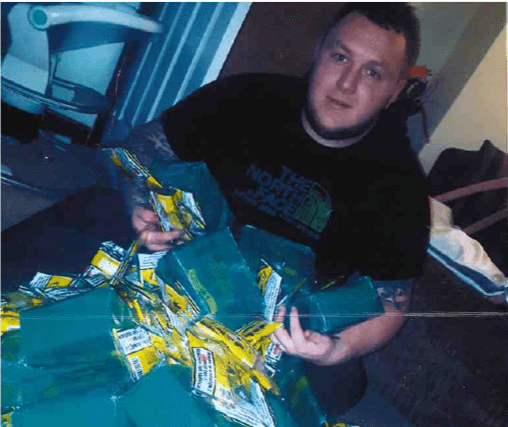
At Llandrindod Wells Magistrates Court on Wednesday, November 7, magistrates heard that officers had seized a large quantity of illegal tobacco from the defendant’s home in November 2017. Samples of the tobacco were tested by Trading Standards and found to contain excessive levels of cadmium, a heavy metal which causes increased health risks.[/vc_column_text][/vc_column][vc_column width=”1/2″][vc_single_image image=”11297″ img_size=”Full”][vc_single_image image=”11314″ img_size=”large”][/vc_column][/vc_row][vc_row][vc_column][vc_column_text css=”.vc_custom_1541759058299{margin-bottom: 0px !important;}”]Magistrates also heard that Rawsthorne used Facebook to advertise his illicit tobacco products. They were informed that trademark holders confirmed that the tobacco was counterfeit and that it did not comply with the appropriate legislation in terms of labelling requirements and the necessary safety warnings were absent. A warrant was executed at the then home of Rawsthorne and counterfeit pouches of Cutters Choice and Golden Virginia product with a street value of £10,000 were found.

Rawsthorne pleaded guilty to two offences under the Trade Marks Act 1994 and four offences under the Tobacco related Product Regulations 2016 – two for not proving the adequate health warns and two for the wording not being in English as required by the regulations.

In sentencing Rawsthorne, magistrates handed down a 12-month community order, and ordered him to carry out 200 hours of unpaid community work.  He was also ordered to pay full costs of £4,670 and a £85 victim surcharge.

Across Wales, illegal tobacco continues to undermine key measures aimed at reducing smoking prevalence, including taxation, labelling, age restrictions on sales and point of sale display bans. It is sold so cheaply that is easily available to those who would not otherwise be able to afford it, including children.

Currently illegal tobacco makes up 15% of tobacco sales in Wales and 45% of smokers in Wales have been offered illegal tobacco products. The average price of a pack of 20 illegal cigarettes is just £4.

ASH Wales is leading the campaign to tackle illegal tobacco in Wales and in 2014, we led the first pan-Wales research project into the illegal tobacco market in Wales. We then went on to support the launch of the Welsh Government’s illicit tobacco programme.

Suzanne Cass, Chief Executive Officer of ASH Wales, said: “We applaud the efforts of all those involved in this successful prosecution and hope this sends a message to others that this activity will not be tolerated.

“Illegal tobacco currently makes up 15% of all tobacco sales in Wales – the highest level in the UK – and continues to undermine efforts to tackle smoking prevalence.

“Criminals sell illegal tobacco at pocket money prices to those who would not otherwise be able to afford it, disregarding all tobacco control measures.

“It represents a major threat to the health of the nation greatly increasing the numbers of those at risk of developing smoking related conditions, which currently contribute to 5,388 deaths and 26,489 hospital admissions a year in Wales.

“This is a crime that threatens lives across Wales and resources must be directed towards helping to stamp it out.”

Since it launched two years ago, Operation Date has had a major impact on the illegal tobacco market in Powys. Describing its achievements so far, Clive Jones, the council’s Professional Lead for Trading Standards, Community safety and Emergency Planning said:

“Over the past two years we have seized nearly 50,000 illegal cigarettes and 50kg of illegal tobacco as part of our overarching operation on illicit products, named Operation Date.

“The supply of illegal tobacco bypasses government tobacco control measures, such as not selling tobacco to children and availability is increasing.  This makes it more likely that youngsters will start smoking and we find that counterfeit products often contain high levels of heavy metals such as cadmium.

“Our surveillance on illegal activity involving counterfeit products of any variety is increasing and we ask users of auction sites or any person offered suspected counterfeit goods to be vigilant and to warn us of any suspicious sellers through our contact points.  Alternatively ring Crimestoppers on 0800 555 111. This action would not have been possible without the support of Dyfed Powys Police and we wish to thank officers from the road policing team and intelligence units.”

Cllr James Evans, Cabinet Portfolio Holder with responsibility for Trading Standards, went on to say that the council is working to raise awareness among smokers of the harm caused by the supply of illegal tobacco.

“Combating the supply of counterfeit and illegal tobacco is one of the priorities of our Trading Standards Service.  We are looking to increase the understanding of the impact it has amongst smokers and local communities when shadow activities occur with illicit products.

“This should also serve as a warning to those involved in the supply and sale of illegal tobacco that we will take the appropriate action with partners that is necessary to combat this.”

Editor’s Notes
Enquiries: Diana Milne | PR Officer ] | diana@ashwales.org.uk | 02920 490621
Or Beth Mahoney | Marketing and Communications Manager | Beth@ashwales.org.uk | 02920 490621|
Interviews available. Please contact using the details above.[/vc_column_text][/vc_column][/vc_row]

ASH Wales echoes Royal College of Midwives’ warning over high rates of smoking among pregnant women in Wales

ASH Wales supports calls by the Royal College of Midwives (RCM) to tackle the high rates of smoking among pregnant women in Wales.

At the launch of the Welsh edition of the RCM’s State of Maternity Services Report, the RCM cited the fact that one in five pregnant women smoked as a ‘real concern’.

It is estimated that 11,864 unborn babies in Wales are exposed to harm from tobacco each year and 16% of all pregnant women in Wales smoke throughout their pregnancy – the highest of all UK nations.

Suzanne Cass, CEO of ASH Wales, said:

“We echo the RCM’s concerns about the high levels of women in Wales who smoke through their pregnancies and the toll this takes on the health of unborn babies.
“Smoking is a highly addictive habit which can be difficult to break, never is this more apparent than in the number of women we see still smoking throughout their pregnancy.

“Being addicted to smoking and pregnant is not a position that any would-be parent would want to put themselves through. We need to work hard to explore every option to help these women quit this deadly addiction. Helping the pregnant women and their family find the right support is a crucial step along that quit smoking journey.”

Helen Rogers, Director for Wales at the Royal College of Midwives, said:

“Smoking in pregnancy is one of the major factors in the UK’s relatively high stillbirth rates compared to many other western nations. If we can reduce the numbers smoking in pregnancy it will be a significant step towards reducing stillbirths.

“The statistics outlined in our Wales maternity report published today are a real concern. One in five pregnant women in Wales are recorded as smokers and we need to address this issue as a matter of urgency. There are also quite dramatic differences in smoking rates between the different areas across Wales. We need to support these women to reduce or ideally stop smoking in pregnancy and support them to remain non-smokers afterwards.”

Risks of smoking in pregnancy
Smoking while pregnant puts both mother and baby at risk of significant harm to their health. Smoking doubles the chances of the baby being stillborn or with a heart defect and second-hand smoke can also have a devastating effect on the health of the child – increasing the chances of Sudden Infant Death Syndrome (SIDS) by 45%.

When a cigarette is smoked over 4,000 chemicals go into the lungs and then into the bloodstream. When pregnant that blood flows into the placenta and umbilical cord and directly into the baby’s body.

The toxic cocktail of chemicals work together to restrict the baby’s oxygen supply. They narrow blood vessels throughout the body, choking the oxygen supply, including the ones in the umbilical cord. Meanwhile the red blood cells that carry oxygen pick up molecules of carbon monoxide reducing oxygen levels.

Smoking can result in a low birth weight, a small baby who doesn’t grow healthily has an increased chance of being stillborn. Smoking also increases the likelihood of a baby being born prematurely, and that he or she will have health and development problems in childhood and later life.

If you are expecting a baby, the best people to speak to for support are your midwife, health visitor, GP or local pharmacy, who are all equipped with knowledge to help and can offer great support, plus advice about nicotine replacement therapy.

Help Me Quit from NHS Wales offers help online and excellent services such as telephone support or one-to-one or group meetings. Find more information at www.helpmequit.wales or call 0800 085 2219 or or text HMQ to 80818.

Editor’s Notes
Enquiries: Diana Milne | PR Officer ] | diana@ashwales.org.uk | 02920 490621
Or Beth Mahoney | marketing and communications manager | Beth@ashwales.org.uk | 02920 490621|
Interviews available. Please contact using the details above.

Leading Housing Chief Elected Charity Chair

One of Wales’s leading housing chiefs has been elected as the new chairman of the tobacco control action charity ASH Wales.

Scott Sanders, CEO of Linc-Cymru Housing Association, has been appointed by the Trustees in recognition of his excellent leadership skills and shared ambition to improve the quality of lives across Wales.

One in five of all Welsh adults still smoke and smoking kills more than 5,000 people in Wales every year. The most deprived and vulnerable in our communities are more likely to smoke and be affected by passive smoking.

Mr Sanders brings 20 years of business experience in the housing and social care sectors to the role and says the connection between housing and health has never been clearer: “Affordable housing plays an important role in providing safe and secure environments from which people can build their lives, but it goes beyond that as everything we do must contribute to people’s health, well-being and prosperity.

“Achieving this will help to reduce the inequality that exists in communities and reduce the correlation between socio-economic status and the prevalence of smoking.”

Smoking has been identified as a leading cause for the gap in mortality rates between the most and least deprived areas of our country.

Chief Executive of ASH Wales, Suzanne Cass, said: “The housing sector in Wales has already made positive steps to improve the health of vulnerable people. ASH Wales are delighted to have a leading figure in this field to help guide our ambitions and strategic path.”

Mr Sanders is passionate about the role the affordable housing sector can play in helping to improve the health and well-being of tenants and believes reducing smoking prevalence is key.

Mr Sanders added: “Welsh Government has set clear expectations for improved well-being and a move from ‘treatment to prevention’ within its strategy ‘Prosperity for All’.

“This is complimented by the Well-being and Future Generations Act that aims to get public bodies to think about the long-term impact of decision making and investment, prevent problems and take a more joined up approach.

“As Chair I am keen to support the reputation that Suzanne has established to be the partner of choice and continue to be known for creating the right type of conversation, significantly influencing the agenda and delivering advocacy to those people not adequately represented.”

Among his achievements, before taking over as CEO of Linc-Cymru, Mr Sanders supported the merger of Newport Housing Trust with Seren Group to create Derwen Cymru, a specialist housing association which is dedicated to improving the lives of older people.

Mr Sanders believes building successful private, public and third sector partnerships is key to reducing health inequalities: “My 20 plus years working in the affordable housing sector has allowed me the opportunity to be involved in housing solutions and services that take advantage of the far larger benefits that arise when housing, social care and health work as one. Delivering cross cutting solutions forms part of my daily work life.”

Mr Sanders went on to say that while moves to reduce smoking prevalence in Wales are encouraging, there is still much work to be done: “The steps taken in Wales to implement tobacco control are positive and have made improvements in health outcomes for those stopping or reducing their nicotine intake and have also helped those affected by second hand smoke.

“Despite the advancements, the cost of smoking to the Welsh NHS specifically, is estimated to be around £302 million per year but could be as high as £436.6 million per year.  There is still a long way to go to raise people’s awareness and support them to make positive decisions.”

Latest projections show the national target of 16% smoking prevalence in Wales by 2020 is unlikely to be met until 2025. Additional support and action is needed to drive down smoking rates and decrease take-up.

How smoking affects your teeth – a dentist’s warning

Dr Nigel Jones is based in Abergavenny and has treated Olympic silver medal winning cyclist Becky James, Swansea City players and members of the Ospreys rugby team.

As president of the British Society for Advanced Dentistry, he is one of the UK’s leading authorities on dental implants. He told ASH Wales about the impact of smoking on dental health, how it affects implants and why giving up works wonders for teeth.

What are the main ways in which smoking effects your dental health?

The main way in which smoking affects dental health is that nicotine reduces blood-flow within existing blood vessels, and the formation of new blood vessels. If we think of blood as being the carrier of nutrients and oxygen around our bodies to maintain health, then reducing blood flow by about two-thirds (which smoking does), means that the body has no reserves of oxygen and nutrients when under stress. It would be a little like tripling the size of Abergavenny without improving water supplies, sewerage, or energy production. Smokers take three times as long to recover from wounds, and therefore have three times as many infections. Major studies by Bain in 2002 and Albreksson in 2015 demonstrate that smokers have two to three times as many dental-implant failures as non-smokers. They also have the same failure rates with gums around natural teeth.

In your experience is there enough awareness among patients about the harmful effects of smoking on their dental health?

We have many sorts of studies in medicine, and one of the most reliable is the cohort study where a group of patients is studied for many years to see the long-term outcome of medication or life-style choices. The first big cohort study published in the 1960s looked at the effects of smoking in British doctors. It was this study that established the link between smoking and lung-cancer. I think that as with excessive alcohol consumption and obesity, most people are aware of the dangers, but choose to believe that in some way they will be immune. After all the visual warnings on packs of cigarettes are stark, but people still buy them.

Once smokers stop smoking, does dental health improve?

If smokers quit, then yes their oral health improves. Blood-flow increases along with the ability to grow new blood vessels faster in a number of months as the effects of nicotine wear off. The ‘sludging’ of the blood vessels due to the more sluggish blood flow in smokers can take two years or more to reduce, and so we need people to have stopped smoking for two years in order to offer guarantees on dental-implants. Of course, some smokers swap smoking for other habits such as sucking sweets, and so may see an improvement in the health of their gums, but increased tooth-decay.

What treatments are available if any, to repair the damage to smokers’ teeth?

Fastidious brushing and cleaning of teeth will prevent the build-up of plaque which causes the wounds at their gum edges, thereby reducing the incidence of infections and the need for repair. It’s a bit like owning a car when you live on the coast, you have to be much more careful to remove salt from the underside of the car to prevent rust.

Can you tell us about how smoking affects the healing process following a dental implants procedure?

As above, smokers heal at a third of the rate of non-smokers, and therefore have three times as many infections. We try to lessen the effects of smoking by burying the implants, and not immediately putting temporary teeth onto them, but it’s still a more risky procedure.

What advice would you give to smokers who are hoping to have dental implants?

It’s a bit like someone wanting to buy an all-electric car with the same range as a diesel car. It can’t be done. You either accept the increased risks posed to dental implants by smoking and the responsibility for fastidious cleaning; or you give up smoking.

Find out more about Dr Nigel Jones work