


Pharmacist offers hope to life-long heavy smokers

It’s never too late to give up smoking – even for those with a life-long 80 a day habit. That’s the message from a pharmacist based at Newport’s Royal Gwent hospital, who is passionate about helping even the most hardened long-term smokers to quit.
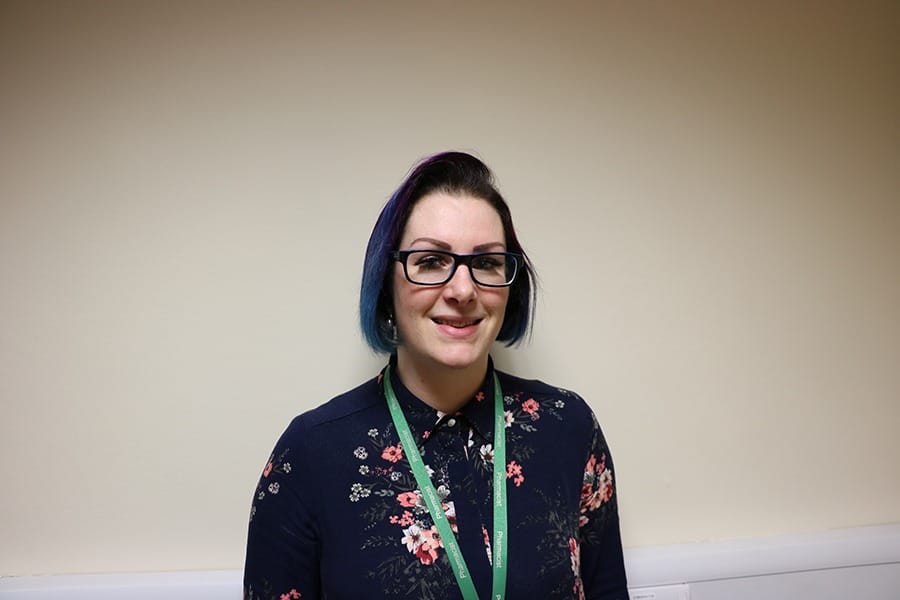
Victoria Richards-Green, works as a pharmacist at the Royal Gwent’s respiratory wards, treating patients with chronic lifelong conditions, many of which have been caused by their smoking habit.
Despite the devastating effect smoking has had on their health, these patients often continue to smoke – putting their health at even greater risk, with the most extreme case Victoria has come across, being a patient with a 200 cigarette a day habit.

Victoria and her colleagues recognised the crucial importance of providing these hardened smokers with the tailored smoking cessation support they required in order to finally quit. They came up with the idea of prescribing Pharmacotherapies, including nicotine replacement therapy (NRT) and varenicline, as well as offering behavioural support to the smokers attending the pulmonary rehabilitation programs they run.
Thanks to their help, around 45% of the patients they have worked with in the programs have successfully quit smoking – even those who thought they had no hope of ever living a smoke-free life.
Victoria described one of the ways they motivate the patients to give up:

“For many of the respiratory patients, when it comes to quitting smoking, health is not a strong motivating factor. In cardiology for instance we see lots of patients who’ve had their first heart attack and they are usually relatively young, so it really motivates them to go on a massive health kick. Whereas older COPD patients are more inclined to be of the opinion that they have already damaged their lungs and there’s no point in stopping.

“So, we often use their grandchildren as motivation, telling them that by stop smoking it will slow the decline of their lungs and given them a better quality of life. They could be around longer to see their grandchildren grow up and will be less breathless and better able to play with them. Quite often that works.”

Patients are seen at the respiratory rehab programs twice a week for six weeks which means there are plenty of opportunities to re-enforce the benefits of quitting smoking. Currently the smoking cessation project is only running in Newport, but Victoria hopes it will be rolled out across the whole Aneurin Bevan health board.
The service is unique, not only because of the frequency of the support offered but also because it is bespoke and tailored to the needs of each individual smoker. This is crucial to its success, says Victoria, who explained that heavy smokers may not respond to the standard quit smoking methods used in primary care services.

“The patients we support are heavy smokers with a heavy addiction and heavy failure rate. They’ve tried all the stop smoking services and all the pharmacotherapies before and nothing has worked.

“When we first meet people in the rehab program, we ask them to fill in a questionnaire to find out how much they smoke and when. We look at the number of cigarettes they smoke per day and whether they get up to smoke at night. We also look at what triggers them to smoke and ask a lot of questions about co addictions such as caffeine and alcohol or other medications.”

Working out the triggers that encourage smokers to light up is a big part of helping them to quit, says Victoria, who describes how she provides behavioural support to help smokers cope with the cravings that crop up at different points throughout their day.
“If we empower smokers with the knowledge of when they are going to struggle, they can deal with it better. Because we won’t be there to help them when they are having a craving.
“We deal with each individual cigarette. So, for the one people smoke after the meal, we may offer them a lozenge or for when people usually take a smoking break, the use of an inhalator. If people always smoke in the car, we say they should make it a smoke-free zone. Sometimes we provide people with multiple different NRT products to use for different circumstances.

We encourage people to find ways to change their daily routines and if they are prepared to do that we know that they are really invested in the process. The pharmacotherapies will do a proportion of it but they have to do the rest.”

Victoria says more than half the patients she works with do not fall within the category of smokers that can be helped by current primary care smoking cessation services, such as pharmacies or the Help Me Quit service.

She believes that many of the remaining 17% of people in people in Wales that smoke tend to have complex needs that require the type of bespoke support that she and her team provide:

“I think that the hardened heavy smoker is becoming the norm. So many smokers have now been treated and the ones that remain are complex. All the smokers I treat have had more than one quit attempt previously and they’ve gone so far then they’ve hit a wall. We’ve got some excellent stop smoking services out in primary care but they just don’t meet everybody’s requirements.”
According to Victoria however, no matter how entrenched their habit is, there is always hope, and a reason for them to quit:
“There’s never not a good time to stop. Even if patients have been diagnosed with lung cancer it’s still worth it because the chemotherapy doesn’t work as well if you are still smoking.

“We’re working with a smoker who was on 80 cigarettes a day. He’s got down to three a day and we’ve changed his NRT and given him two patches a day and he’s well on his way to quitting. Everybody is capable of quitting – it’s just about using the right products and at the right amount.

“You’re not the reason why you’ve failed. You have been undertreated so are relying too heavily on will power. And if that’s happens, you’re setting people up to fail.”

Newport School’s Smokefree Success

Before the introduction of a Smokefree School Gates policy at Malpas Court Primary School, parents would gather from 3pm onwards to smoke before picking up their children.

The school became increasingly worried about the impact the clouds of second-hand smoke would have on the health of staff and pupils.

They were concerned too that the sight of parents lighting up within clear view of the playground and even some of the classrooms, would normalise smoking in the eyes of children.

The decision was made to introduce a Smokefree School Gates policy at the school and to involve the pupils as much as possible in the launch of the policy.

A competition was held for children to design posters and flyers to be displayed around the school and on the school gates.  Letters were sent home to parents and teaching about the harms of smoking was incorporated into children’s lessons so that they would understand the reason for the policy.

When the policy was introduced, there were no negative reactions from parents. And although some parents do occasionally smoke by the school gates, the introduction of a smoke free policy means staff no longer feel uncomfortable about asking them to move away or put their cigarette out.

One Year Four teacher Claire Harvey who is also the school’s Wellbeing Coordinator, described how the introduction of the policy has benefited staff and pupils:

“We’re a nurture school as well as a rights respecting school, so this policy fits in perfectly with our ethos.

“Since the introduction of the policy we don’t have that many smokers on the gate so that shows that they are respectful, and they want to keep that as a healthy area for our pupils.

“When people do smoke, we haven’t had any unfortunate situations that have made us feel uncomfortable. Usually people just need a friendly reminder and are happy to put their cigarette out or move away.

“The children do like to ask questions and by being involved in that campaign they want to know why we are doing it and why it’s important for us to keep that a smoke free area and it allows that opportunity to educate them  so they fully understand and are aware of the issues there.

“It fits in with our curriculum. It’s a science topic so it lends itself to the well-being side of things. That is our priority – the health and well-being of our pupils and our staff and the community and the parents. We’re one big family really so it fits in perfectly with that.”

Find out more about ASH Wales’ Smokefree School Gates campaign here 

If you’re interested in the smokefree school gates campaign please get in touch with kimberley@ashwales.org.uk 

ASH Wales and the Royal College of Midwives call for action after figures reveal a third of pregnant teenagers in Wales smoke

[vc_row][vc_column][vc_single_image image=”13948″ img_size=”1200×600″ alignment=”center”][vc_column_text css=”.vc_custom_1579777940027{margin-bottom: 0px !important;}”]ASH Wales and the RCM are calling for urgent specialist support for pregnant Welsh teens after new figures showed that 30% are still smoking throughout their pregnancy – double the national average for mums-to-be in Wales.

The latest figures released by Welsh Government reveal teenage mums-to-be are the most likely to smoke and to continue to smoke whilst pregnant with 30% of 16 to 19-year-olds smoking at the time of their baby’s birth and 33% at their initial assessment. This compares to 16% of all pregnant women across Wales that smoke throughout pregnancy and 18%

that are recorded as being a smoker at their initial assessment.
Smoking rates were lowest among women aged 40 to 44, with just 9% smoking through pregnancy. Meanwhile 16% of 25 to 29-year-olds smoked at the time of their baby’s birth.

Smoking during pregnancy increases the risk of miscarriage by over 25%, doubles the chances of a stillbirth and increases the risk of the baby being born with a heart defect by 50%.

Despite campaigns to raise awareness of the dangers of smoking whilst pregnant, there has been limited change in prevalence figures over the past few years.
The tobacco action group, ASH Wales says these latest figures from the Maternity and Birth Statistics, Wales 2018, highlight the need for targeted support for teenage mums and increased education on the dangers of smoking whilst pregnant.

ASH Wales CEO Suzanne Cass, said: “It is clear that these young mums-to-be need more support to help them quit this highly addictive habit. We know quitting smoking can be very tough, particularly for vulnerable teenagers facing the challenge of pregnancy and motherhood at a young age.

“These pregnant teenagers need specialist stop smoking services, tailored to their needs and delivered in the communities in which they live. In addition, the life-threatening effects of smoking to an unborn child and the dangers of second-hand smoke should be embedded into the education of teenagers across Wales.”

The Royal College of Midwives (RCM) is backing ASH Wales’ call for more specialist stop smoking services to be available for pregnant women in Wales. Helen Rogers, the RCM’s Director for Wales, said: “Smoking in pregnancy can have a significant and serious impact on the developing baby. Babies born to those who smoke in pregnancy are more likely to be born prematurely and have a low birth weight.

“Stopping smoking in early pregnancy can almost entirely prevent adverse effects, yet too many maternity services are without a stop smoking specialist midwife in their team. Given that smoking is a marker of inequality, the RCM believes that specialist stop smoking services should reflect the local need and must be offered by all Health Boards with maternity services in Wales.”

Across Wales 9% of 15-to-16-year-olds smoke at least once a week, a figure that has remained unchanged since 2013-2014 and more than 11,000 children still take up smoking in Wales every year. Prevalence is highest among the poorest teens with 46% of year 11 students from the most deprived families first trying a cigarette aged 13 or younger compared to 34% of the most affluent.

ASH Wales is calling for more to be done to prevent young people from taking up the habit – a move that would mean less teenagers smoking during pregnancy.
“In Wales a classroom’s worth of young people continues to take up smoking every single day and those that take up the habit earlier in life are the most likely to become heavy smokers later in life and the least likely to quit,” said Ms Cass.

“It is crucially important that we break these cycles of health inequality by putting measures in place to stop the teenagers of today from becoming the hardened lifelong smokers of tomorrow and endangering the health of their families for generations to come.”

To read about a project in Swansea that has achieved a 25% success rate in helping pregnant teens to quit smoking  click here[/vc_column_text][/vc_column][/vc_row][vc_row][vc_column][/vc_column][/vc_row][vc_row][vc_column][vc_single_image image=”13763″ img_size=”700×350″ alignment=”center” onclick=”custom_link” img_link_target=”_blank” link=”https://www.helpmequit.wales/”][/vc_column][/vc_row]

Project achieves 25% success rate in helping pregnant teens quit smoking

A PROJECT that supports vulnerable families in Swansea has helped hundreds of young mums-to-be to quit smoking.

Jig-so, has achieved a 25% success rate in helping pregnant young women to quit the habit – protecting babies from potentially life-threatening health risks.

The project set up in 2016 between Swansea Council and Swansea Bay University Health Board, provides early intervention and support to young families facing challenges such as anxiety and depression, poverty, domestic violence, drug and alcohol addiction and homelessness.

Young pregnant women ranging in age from 14 to 25-years-old are referred to the service by their midwife and receive one-to-one home visits from the team throughout their pregnancy, attend group antenatal sessions then receive parenting support once their baby is born.

Meanwhile struggling young families, many of which rely on foodbanks for survival, are given crucial parenting support resulting in many children having been taken off the social services at risk register.

Giving advice on the benefits of quitting smoking is just one part of the team’s role, but it is one that midwife Julie Morgan feels is crucial, given both the health and financial benefits of giving up. She said: “We are very proud of what we have achieved in helping 25% of the young women we work with to give up smoking.

“When we meet them, we find that many of them are completely unaware of the harm it can cause to their babies. A lot of them come from homes where generations of their family still smoke and many of them buy and smoke contraband cigarettes because it’s cheaper and they get to buy twice as many.
“Many of them say they don’t want to give up because they want to have a small baby. Others say that if they try to quit it will stress the baby. But when we tell them what smoking can do to their health and their health of their babies they are shocked.”

According to Julie around 40% of the pregnant women the team supports smoke. They are given advice on quitting by their midwife throughout their pregnancy and regularly have their Carbon Monoxide levels monitored to see what progress they’ve made.

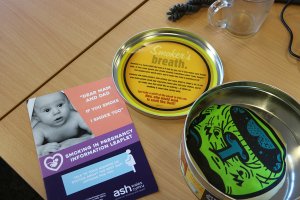
Smoking cessation advice also forms a key part of the group antenatal sessions the team provides, and they use a range of props to illustrate why it’s a good idea to quit, including a ‘chemical soup’ containing all the ingredients found in cigarettes, jars of tar, a set of smoker’s teeth and flipcharts of graphic images showing parts of the body affected by smoking.

The team also emphasises the cost of smoking to the women, many of whom are already facing challenging financial circumstances, made worse by their smoking habit.

The most effective tactic however is to build up trust with their clients, said Julie: “It’s a very gradual process. But visiting them at home means we have a real opportunity to build a relationship with them.

“To build up that level of trust, we can’t just go into the first appointment and start talking about smoking straight away. We have to approach the subject in a sensitive way and make sure they don’t feel judged.”

As well as supporting mums-to-be to stop smoking, the team also provide smoking cessation advice to the women’s partners and to the young families they support. Their aim is to encourage families to have smoke-free homes and to protect to their children from the effects of second-hand smoke in particular, the risk of sudden infant death syndrome in new-born babies.

Thanks to their efforts, says Julie, none of the young parents they visit in their homes smoke around their children and those that struggle to quit are encouraged to at least smoke outside the home.
For the young women that do manage to quit the habit, however, the effects can be powerful, not only on their health but on their self-esteem, as Julie explains:

“Lots of the girls we work with feel they have never achieved anything in life. They have seldom been praised or encouraged for anything they’ve done and they feel so proud of themselves for quitting for the sake of their baby’s health and proving to themselves that they can do it.”

Leading Welsh health experts urge smokers to quit in 2021

Leading Welsh health experts are urging smokers to quit the habit in 2021 as growing evidence shows they are more at risk from Covid-19.

They say quitting should be top of every smoker’s New Year Resolutions list with smokers up to three times more likely to be infected by Covid-19 according to the latest research by American scientists.

Smoking is already the biggest cause of avoidable disease and early death in Wales, killing more than 5,000 people a year. It places a huge burden on an already overstretched NHS in Wales, costing the organisation around £302 million a year.

Research has shown that smokers are more likely to suffer more severe symptoms if they catch the virus. Meanwhile a study by the University of California in Los Angeles has shown that smokers could be 2 to 3 times more likely to be infected by Covid-19 due to the damage smoking causes to the body’s lung tissue defences.

Fears over the increased risks from the virus added to the motivation of thousands of smokers to quit in 2020. NHS Wales’ Help Me Quit service saw a rise in calls and has made sure that all smokers are supported by expert advice over the phone and free medication.  Research carried out by ASH and University College London found that an estimated 33,000 Welsh smokers had quit smoking since the start of the Covid19 pandemic and that 41% of smokers surveyed across the UK cited Covid-19 as their main reason for giving up.

ASH Wales has launched its Any Age Any Stage campaign. ASH Wales CEO Suzanne Cass, said:

“Our message to smokers is that it really is never too late or too early to give up.

“No matter how long you’ve been smoking for the health benefits of quitting are huge. Within just 20 minutes of smoking your last cigarette, your body will start to recover and after a year you’re 50% less likely to have a heart attack or stroke.

“If you’re a young smoker you may think you’ll give up when you’re older. But the damage has already started with every 15 cigarettes you smoke leading to a mutation in your cells that could later cause cancer.

“This is not something you can delay. For every smoker out there, old and young, quitting should be an urgent priority.”

Ashley Gould Consultant in Public Health at Public Health Wales. He said: “

“New year is a time when many people decide to quit smoking and with free NHS support smokers are four times more likely to quit for good compared to trying on their own.

“Covid-19 has brought about added risks to smokers and as a result, we have seen more and more smokers trying to quit. There really has never been a more important time to quit smoking, and the best way is to search ‘Help Me Quit’ or call 0800 085 2219 today. Let 2021 be the year you stop smoking for good!”

Keir Lewis who is Professor of Respiratory Medicine at Swansea University and Respiratory Lead at Hywel Dda University Health Board, said:
“My experience in respiratory and general medicine has shown me first hand that smoking destroys so many lives directly and maims others. There has never been a more important time to quit smoking to protect and improve your health. Smokers certainly get worse COVID disease as well as so many other avoidable cancers, heart disease and lung problems.

“We know giving up this highly addictive drug isn’t easy. But there is free support available across Wales and if you work with a specialist, you will increase your chances of quitting long-term by 300%!

Dr Brigitte Gomperts is Professor of Pulmonary Medicine at UCLA and co-author of the research claiming smokers are three times more likely to catch Covid-19 and that they are at higher risk of suffering more severe symptoms. She said:

 “My message to smokers is that smoking puts you at increased risk for more severe COVID-19 and this is therefore a great time to stop smoking. There are many new products available to help you stop smoking and I would suggest that you contact your GP to find out more.”

Case study: Sarah Wray, a 45-year-old mum of three and support worker from Carmarthenshire, recently recovered from Covid-19. She gave up smoking in 2019. Here she describes her experience of quitting and her relief at having given up before contracting Covid-19.

She said: “I smoked for 20 years and finally decided to quit in November 2019 after suffering a chest infection.

“Once I decided to quit, I had one to one help from my GP and used champix. To help with cravings I changed my mindset and used nicotine spray.

“Quitting made a big difference to my life. I feel more confident, I’m not coughing as much. I sleep better and I have more energy so I can walk further with my dog. My family being proud of me makes a big difference, especially my children as I did not realise the effect it had on them.

“I was recently diagnosed with Covid-19. I had mild symptoms the worst one being shortness of breath. In the end I was ill for 10 days. I’m just so glad I gave up smoking because I know it would have been much worse if I hadn’t and it would have taken a lot longer to get over.

“We all have different reasons for quitting but my message to smokers would be to please give it a go.”

Expert quit smoking tips

The start of a new year is the most popular time to embark on a quit smoking attempt. To help you to get started, we’ve put together a list of top quit tips from our brilliant team of smoking cessation experts.

“All the evidence we have suggests vaping is much safer than smoking. Make sure you use a regulated product sold from a retailer you trust, and if you can, also get support from a stop smoking advisor.” Jamie Hartmann-Boyce Senior Researcher at the University of Oxford’s Nuffield Department of Primary Care Health Sciences.

“Simply staying away from situations where you would normally smoke can limit cravings. When cravings strike it is very important to do something positive – not just wait them out. Simple breathing exercises can help and so can going for a walk or finding something interesting to occupy the mind. Cravings are often worst in the evenings and going to bed early is something a lot of smokers do.”  Robert West professor of Psychology at University College London and author of The Stop Smoking Formula.

“Choosing the right support is really important. Cutting down just makes cigarettes seem more precious – so our advice is always to carry on smoking as normal until you stub out your final cigarettes. Advice differs for other methods – so my number one advice would be to follow the instructions of whatever method you use.” John Dicey, CEO of Allen Carr’s Easyway stop smoking method.

“When we experience cravings and they are intense, it can be a good tactic to remind ourselves of the consequences if we pick up a cigarette once more. One good way to support this may to make two lists.
1 – What will life be like 5 years from now if I continue to smoke – maybe include “I’ll be less fit, I’ll have more health issues, I’ll have less money…”
2 – What will life be like in 5 years if I stop smoking? – maybe include “I’ll be healthier, I’ll be fitter, I’ll have more money, my clothes will be fresher…” Steve Clarke is clinical and therapy services manager for The Priory Group

“Smoking is a powerful addiction so why not get medical help. I don’t see any difference between smoking addiction and a physical illness. If you had diabetes for instance you would think nothing of seeking medical help. There is plenty of support out there so why make life difficult for yourself when giving up smoking is the most important thing you can do for your health.” Dr Alex Bobak, GP and smoking cessation specialist

“The key to success is about people being in the right frame of mind. I try to avoid starting people on the stop smoking programme if they are going through a particularly stressful time in their life or if they have a holiday or big celebration coming up. If people are really struggling I’ve learnt to say ‘let’s draw a line under this. Don’t beat yourself up’. I give them a handshake and say well done for trying.”
Gwawr Davies Jones, pharmacist who provides smoking cessation support.