Number of Adult Smokers in Wales Fails to Fall

New statistics, released by Welsh Government, show the number of smokers in Wales has failed to decrease with a fifth of all adults still smoking.

The National Survey for Wales, an annual survey which looks at a variety of lifestyle and well-being issues, questioned 11,000 people from across the country.

  • 19% of adults reported they currently smoke
  • Smoking is more common for men
  • Smoking is more common in those in deprived households
  • Smoking is less common among people aged over 75

Suzanne Cass, Chief Executive of tobacco control charity ASH Wales, said: “A significant amount of work is being done to reduce smoking rates including the creation of a revised delivery plan for Wales, a ‘new look’ smoking cessation service Help Me Quit and the introduction of more measures to protect children through the Public Health Act. However, it is quite clear there needs to be additional action to help people quit and to stop children taking up this deadly habit.

“Two thirds of all smokers would like to quit and around 40% of smokers try to give up every year. We need to make sure those who want to quit have the right support for them – whether that’s through their GP, the local pharmacy, using an e-cigarette or through the dedicated support service Help Me Quit.”

Disappointingly the number of people using an e-cigarette remained static at 7%. Evidence has shown that e-cigarettes can help people cut down or stop smoking.

Andy Glyde, Public Affairs Manager (Wales) at Cancer Research, said: “Smoking is a ‘deadly habit’ and causes at least 14 different type of cancer. It’s shocking that 3,000 cases of cancer a year in Wales are caused by tobacco.

“Far too many people in Wales are still smoking and much more needs to be done to help them quit and to reduce deaths from smoking related cancers. We know that NHS stop smoking services are the most effective way of helping people to quit smoking.

“It’s vital the Welsh Government takes forward its promises in last year’s Tobacco Control Action Plan, to invest in and promote these services.”

A full report about health-related lifestyle factors (smoking, alcohol, diet, obesity and exercise) was released on Wednesday 27th June, and can be seen here.

Action to Stamp Out Illegal Tobacco on World No Tobacco Day

Sniffer dogs and Trading Standards officers will be on the streets of Port Talbot today (Thursday 31st May) asking the public to tell them what they know about the sale of illegal tobacco in their communities.

The roadshow, outside Port Talbot’s Civic Centre, is part of an international day of action to mark World No Tobacco Day and follows a report which showed the illegal tobacco market makes up 15% of all tobacco sales in Wales – the highest in the UK.

These cheap products make it easier for children to start smoking as it is sold at pocket money prices by criminals who don’t care about age restriction laws.

Neath Port Talbot’s smoking rate stands at 24%, the highest in Wales, and 5% higher than the national average of 19%.

Hosted by Neath Port Talbot County Borough Council, members of the public will have the opportunity to meet sniffer dogs, Trading Standards officers and the Police to discuss and report illegal tobacco in their community.

Cigarettes and hand rolling tobacco are classed as illegal if they’ve either been smuggled into the country, bought abroad as ‘duty free’ and avoided UK taxes, or are counterfeit products made to look like big name brands.

The ‘illicit’ tobacco trade, as it is also known, is linked to serious organised crime at a local and national level and is related to other crimes including money laundering, modern slavery and child exploitation.

The first roadshow is taking place outside Port Talbot’s Civic Centre a second event is being held at Angel Square, Neath on Friday (1st June) from 10.30am.

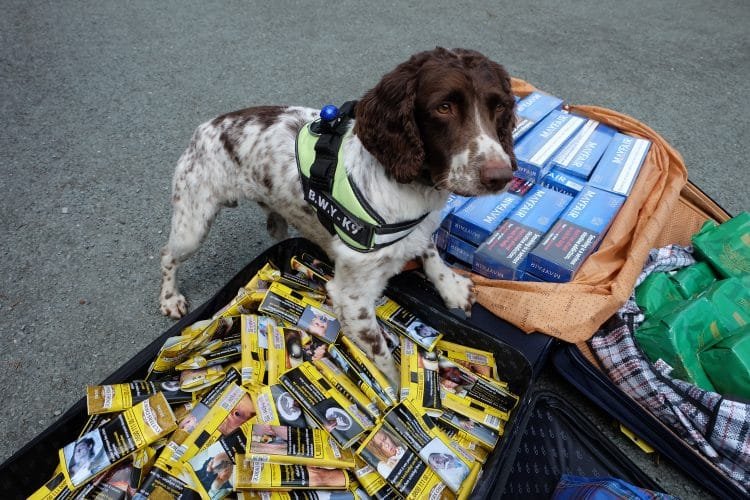
Attending the roadshows will be sniffer dog duo Yoyo and Scamp who have been specially trained to find concealed tobacco and have uncovered more than £12m illegal tobacco products in various raids across the UK.

Illegal tobacco is not just sold from ‘under the counter’ in shops; children are visiting criminal’s houses to buy cigarettes or hand-rolling tobacco, meaning they regularly encounter adults who might be selling other illicit goods.

Research shows children are more likely than adults to be offered illegal cigarettes and the low price makes it much easier for them to buy and get hooked on tobacco.

The cheapest pack of illegal cigarettes found recently by an ITV Wales investigation was a Russian brand not sold in the UK which cost just £3 – a legitimate packet of 20 cigarettes costs between £8 and £12.

World No Tobacco Day is an international day of campaigning and action to raise awareness of the life-changing impact tobacco causes worldwide. Coordinated by the World Health Organisation, each year World No Tobacco Day has a central theme and this year’s is around the damage smoking does to the heart.

Stopping smoking is the single best thing someone can do for their heart health with smokers being twice as likely to have a heart attack compared with people who have never smoked.

Suzanne Cass, Chief Executive of tobacco control charity ASH Wales, said: “No matter where tobacco comes from, it is harmful but illegal tobacco is an added risk because it is sold to children and brings crime into our communities.

“Smoking is an addiction which nearly always begins in childhood. The availability of cheap cigarettes – sold by criminals who don’t care – gives children the opportunity to start a life-long and potentially deadly habit.”

Councillor Des Davies, Cabinet Member for Community Safety and Public Protection, said: “Illegal cigarettes are sold at pocket money prices by criminals who are happy to profit from our children’s future. This is why I am so keen that we get them off our streets, and it’s why this campaign is so necessary.”

A tobacco control alliance recently backed calls for a Wales-wide programme to tackle the illegal tobacco problem in Wales.

As part of their illegal tobacco campaign, Neath Port Talbot County Borough Council has produced a series of hard hitting posters encouraging people to report illicit tobacco sales by e-mail (tsd@npt.gov.uk) or by ringing their dedicated hotline on 01639 686877.

ASH Wales comment: Hospital Grounds, School Grounds and Playgrounds to be Smokefree in Wales by Summer 2019

Wales is set to be the first country in the UK to extend its smoking ban to outdoor areas, with smokefree areas expected to be in place in hospital groundsschool grounds and playgrounds by summer 2019.

Strengthening the laws around smoking in public in Wales will further protect non-smokers from second-hand smoke and de-normalise smoking for children and young people.

Suzanne Cass, Chief Executive of tobacco control campaign group ASH Wales Cymru, said: “This raft of smokefree legislation is the most important Wales has seen for our nation’s health since the indoor smoking ban in 2007. These laws are a major public health achievement and will further Wales’ profile as the UK lead in tobacco control measures.

With a classroom of young people still taking up smoking every day in Wales it is essential we make sure children do not see smoking as a normal, everyday activity. We must set positive examples wherever we can.

“Creating smokefree spaces for all, but especially where children and young people play and learn will have an impact on their future health-related habits. We know young people are highly influenced by what they see around them and children with one parent who smokes will be 70% more likely to become a smoker themselves.

“Support for banning smoking at communal outdoor spaces – such as at hospital grounds, school grounds and playgrounds – is high in Wales. A 2017 YouGov poll showed that 71% agree smoking should be banned in hospital grounds, 61% agree with banning smoking in recreational spaces such as parks and beaches and an overwhelming 83% think smoking should be banned at children’s playgrounds, including 56% of smokers.

“We, as well as organisations such as Cancer Research UK and British Heart Foundation, have worked tirelessly over the past few years to provide strong evidence to support the tobacco control aspects which will now come in next summer.”

Read more: ASH Wales Welcomes New Laws Protecting Children from Smoking (May 2017)

Myth-busting: smoking and stress relief #MentalHealthAwarenessWeek

This post is mostly taken from a 2017 blog written by our sister organisation ASH Scotland’s Chief Executive Sheila Duffy (in “…”), with relevant additions by ASH Wales.

This year’s Mental Health Awareness week runs from 14th to 20th May and its theme centres around tackling stress, often linked to smoking.

A survey by the Mental Health Foundation found that around 74% of people in the UK felt so stressed in the past year they felt overwhelmed or unable to cope1. Raising awareness around stress as a mental health factor should be congratulated – weeks like this encourage and give individuals the knowledge to prevent stress in the first place and it provokes conversations around tackling the societal factors behind such high rates of stress.

In 2016-17, around 36% of adults in Wales with a mental illness smoked2, compared to 19% among the general population3. Between 2008 to 2015, this figure barely changed in Wales4; and this is especially concerning when compared to falling rates for the general population. People with mental ill health smoke more than a third of the tobacco consumed in the UK5 and smoking is the biggest contributor to people with mental ill health dying 10 to 20 years earlier than the general population6. Yet tragically, although many people smoke to alleviate stress and symptoms of mental illness, the evidence suggests smoking does not help and may even harm long-term anxiety and mental health outcomes.

This year’s Mental Health Awareness Week – recognising the importance of tackling stress and finding healthy evidence-backed ways to deal with it – goes to the heart of why mental health is so important to ASH Wales’s work to reduce the harm and inequality caused by smoking.

“We ourselves may not be best placed to help reduce the pressures, stresses and strains in life which contribute to mental ill health. We do, however, have something important to say about smoking as the coping mechanism that so many people automatically reach for.”

“I am not at all surprised that people reach for a cigarette at times of need. The public image of smoking has moved on from the glamour and sophistication of the golden age of Hollywood. Smoking still features prominently in the media but is now often used as shorthand to signify someone in distress, sucking in relief through a tobacco straw.”

“Personal experience often reinforces this image. Whatever complicated morass of deep breaths, concentration, familiar routine and relief of nicotine cravings is actually taking place, the take-away memory will be that smoking has helped relieve stress.”

“Finally, there is the extraordinary ease of access to cigarettes. Six decades after the proof that smoking kills, and for all the talk of tough government restrictions on smoking, cigarettes remain ubiquitous in our society, sold without license in every corner shop, garage and supermarket at an average price of 35p each. Imagine a world where other, less harmful, coping mechanisms were as visible and readily available?”

Whatever the immediate impression, the evidence suggests that smoking does not relieve mental ill health in the long-run7; despite this myth having been perpetuated by the tobacco industry8. Many research papers find it may even be harmful to mental health in the long run9,10 and as well as to physical health.

“It is easy to be misled by the apparent calming effects, but it should come as no surprise that the psychological boom-bust of nicotine cravings does not enhance overall mental well-being. Nor does the financial cost, or being out of breath or in pain, contribute to reducing anxiety.”

“The fact that smoking limits the effectiveness of many medications, leading to increased dosage and side effects, was the chief concern expressed by mental health services users we recently consulted with.”

We now know that stopping smoking is associated with improved mental health11,12, especially if supported with relevant mental health treatment13. Most people with mental health issues who smoke say they want to stop, so shouldn’t those people be offered stop smoking support as quickly and easily as psychotropic medications?

“We do have work to do in exploring and developing the alternative, less harmful, coping mechanisms that can help people build resilience in the face of their problems. Yoga or mindfulness may be great, but only if you are someone who will do yoga or mindfulness. For others it might be knitting, computer games, an e-cigarette, walking, Facebook, or phoning a friend.”

“Every individual’s situation is different, the needs they are trying to address will be different, and the alternatives to smoking that might work for them will be different. What could make the difference is a conversation, centred on the individual, their needs, and the approaches available for them to consider and try.”

“That kind of discussion takes time, but support staff already have the skills. Smoking is the biggest contributor to people with mental health issues dying 10-20 years earlier than the general population. Surely it merits a conversation?”

Further reading:
Smokers Encouraged to Quit for Holy Month of Ramadan

Smokers celebrating Ramadan are being encouraged to get support and advice to quit smoking for the holy month which begins today (Tuesday 15th May).

Ramadan is an annual event in the Islamic calendar and it is most well-known as the time when Muslims abstain from eating, drinking and smoking from sunrise to sunset.

Known as fasting, it is forbidden for anything to reach the stomach during daylight hours. This inspires self-restraint and time to reflect, bringing worshippers closer to their God, Allah.

Quitting smoking is the best thing anyone can do for their health with 1 in 2 long-term smokers dying from a smoking-related illness. In Wales, 19% of the population currently smoke.

Help Me Quit is Wales’ free NHS service offering one-to-one advice on the phone and in person or group support to anyone wanting to kick the habit. Help Me Quit can also recommend which nicotine replacements, such as patches or gum, are most suitable and they can direct would-be quitters to get help from their GP or local pharmacy for free.

Thousands of people quit for good with the help of NHS services every year and studies show that smokers are up to four times more likely to quit successfully if they use a combination of stop smoking medication and specialist support, such as with Help Me Quit.

Chief Executive of tobacco control charity ASH Wales, Suzanne Cass, said:“Ramadan is a fantastic opportunity for Muslims who are looking to stop smoking to finally make that hard step.

“Any amount of time smokefree gives the body – especially the lungs and bloodstream – the time to breathe again and take in the clean air needed to recover.”

“Here in Wales we have a flexible and welcoming stop smoking support service, Help Me Quit, who are just a click or a phone call away. Quitters can also pop into their local pharmacy or chat to their GP to find the best way of quitting for their circumstances.” To get free, local, and tailored advice visit www.helpmequit.wales, text ‘HMQ’ to 80818 or phone 08000 852 219.

Quit Support for Swansea Smokers in New GP Scheme

GPs and practice staff across City and Bay Health in Swansea are taking part in a new pilot project offering free breath tests and support for smokers to help them quit.

There are around 20,000 smokers living in the City and Bay Health areas, but the latest figures show less than 3% of these are accessing Wales’ free stop smoking service Help Me Quit every year.

Tobacco control charity ASH Wales has created the new project to help GPs and practice staff to increase the number of would-be quitters getting the right support and nicotine replacement for them.

Smokers who are supported by specialist services, like through their GP or local pharmacy, are four times more likely to stay quit than those who go it alone.

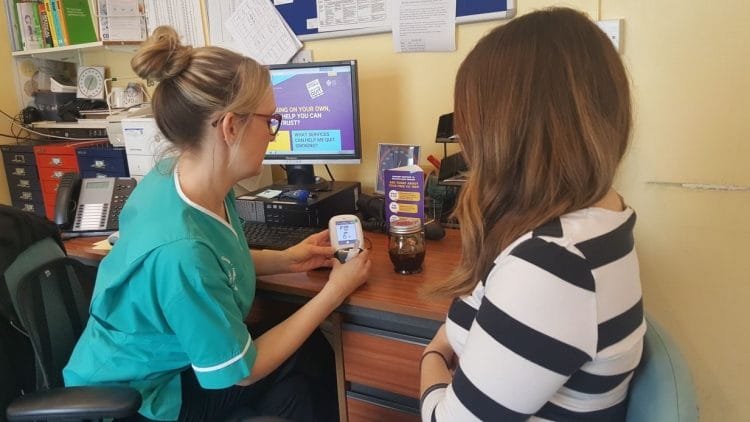
In partnership with pharmaceutical company Pfizer, ASH Wales have provided 27 GP surgeries with ‘smoke’ breath monitors; hand-held devices which take just a matter of seconds to show a patient the current level of carbon monoxide – poisonous smoke – in their body.

Using a colour-coded traffic light system, patients can see the amount of damage they are doing to their bodies, acting as a powerful motivator to think about acting to conquer their habit.

Dr Kirstie Truman, Lead GP for the Bay Health Cluster, said: “Smoking has a devastating effect on the lives of so many of our patients, causing cancer, lung disease and heart problems. Working together to support smokers to stop will help reduce the number of people developing these fatal diseases.

“Allowing patients to see the level of carbon monoxide in their lungs will hopefully prompt them to seek nicotine replacement therapies and stop smoking. The best possible thing for anyone’s lungs is to quit smoking and to stay away from others smoking around them. Quitting smoking isn’t easy but there’s free support and advice available.”

Research shows near 70% of all smokers want to quit but finding information and getting the right advice can be a crucial part of that stop smoking journey.

Wales’ dedicated stop smoking service Help Me Quit has recently expanded the choices offered to smokers with the majority of local pharmacies in the area now offering one-to-one support.

Chief Executive of ASH Wales, Suzanne Cass, said: “It’s a shocking fact that almost half of all long-term smokers will die from a smoking-related disease. Anything we can do to bring down these worryingly high statistics is vital.

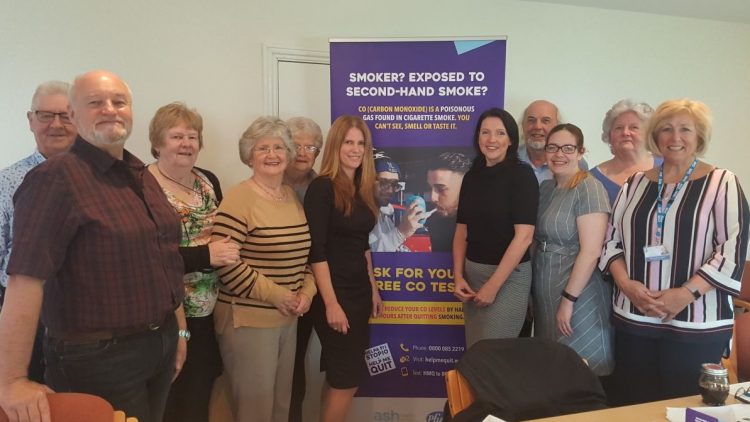
“We’re delighted to be working with so many GPs from across City and Bay Health – every waiting room across these areas will now have information prompting smokers to ask about their free CO test. We must give smokers every opportunity, such as a trip the doctor’s, to get advice and support that could help them quit.”

Latest statistics show that if current trends continue and no additional action is taken the national target of 16% of adults smoking by 2020 will not be met. According to recent figures by the Public Health Wales Observatory, the 16% target will instead be reached in 2025.

Smoking is the leading cause of cancer and the single largest preventable cause of illness and death in Wales, causing over 5,300 deaths every year. 19% of the Welsh adult population currently smoke but this rises to 21% for the Abertawe Bro Morgannwg area – equating to around 92,000 smokers.

The Help Me Quit service and website offers tailored advice specific to the needs of would-be quitters. To find out more call 0800 085 2219 or visit helpmequit.wales

If you live in the Swansea Bay or City areas, look out for signs in the waiting room of your GP surgery about how you can get your free CO test today.