

ASH Wales Chair, John Griffiths, steps down after 30 years in tobacco control

Three decades of working in tobacco control is not achieved without notching up a few battle scars along the way.

Our Chair John Griffiths retires from ASH Wales today after more than 30 years of dedicated service.  John’s versatility of character has led to him being appointed to every position possible on our board. His commitment, integrity and knowledge meant the trustees could not let him go and in 2012 he was ‘invited’ back from retirement to ‘give the charity just one more year’. Thankfully John chose to stay.

When John first joined the charity he had his work cut out, 30% of the population were smoking including 20% of 15-year-old girls and 16% of 15-year-old boys.  The tobacco epidemic was out of control.  In 1984, to stem the tide of young people taking up this deadly habit, the infamous “No Smoking Day” was launched on ASH Wednesday. This national campaign was in media terms ‘massive’ and over the years became a day that made every smoker in the country think about their habit. It was brought about by a collection of organisations run through a committee chaired by John for several years.

In tandem the Government, supported by ASH and its third sector partners, took action and banned the sale of all tobacco products to under 16’s….and over the next few years a raft of policies designed to protect children followed.

TV advertising was banned, they stopped smokers from lighting up on planes, health warnings were made bigger and more hard hitting.
But still the tobacco epidemic spread like cancer through our communities, ten years later in 1998 smoking rates among children hit an all time high. 29% of all 15-year-old girls and 21% of all 15-year-old boys were now smoking. The effects of these astronomically high smoking rates would blight the health of the nation for decades.

More needed to be done, we needed more campaigns, a unified approach and government support.

John helped to galvanise this support on an international scale: working for the World Health Organisation Euro on issues around smoke free workplaces training and bringing together like-minded people. Education, health and workplace services have been at the heart of everything that John has done and continues to do.

Eventually, with leadership from Euro and the tobacco control framework, tobacco controls began to be tightened. The tobacco companies finally started to feel the squeeze as prices were hiked, advertising in sport was banned and sponsorship was censored. Bigger warnings, better education and increased controls eventually led to the number of young people smoking starting to fall.  In 2006 the number of 15-year-old girls smoking had fallen to 23% and boys down to 12%.

But the most significant change in tobacco control was still to be implemented. The banning of smoking in public enclosed space has been the biggest contributor to tobacco control in a generation. The battle to get the legislation was a fierce one, the tobacco companies fought it tooth and nail claiming it would drive smokers from the pubs into their homes and more children would be exposed to second-hand smoke.  But John, ASH Wales and a steady line of tenacious Assembly Members led the charge and in 2005 a welsh cross-party Committee on Smoking in Public Places concluded that ‘there is overwhelming evidence that environmental tobacco smoke is damaging to health and there is no evidence that the introduction of a ban would have an overall negative impact on the economy’.

In April 2007 the ban comes into force – ten years later the ban has led to a step change in the way smokers behave particularly around children. The number of those who smoke in the home has reduced from 80% to 46%, suggesting a massive cultural shift.  The number of smokers in Wales has fallen by nearly 100,000. We are indeed a much healthier nation.

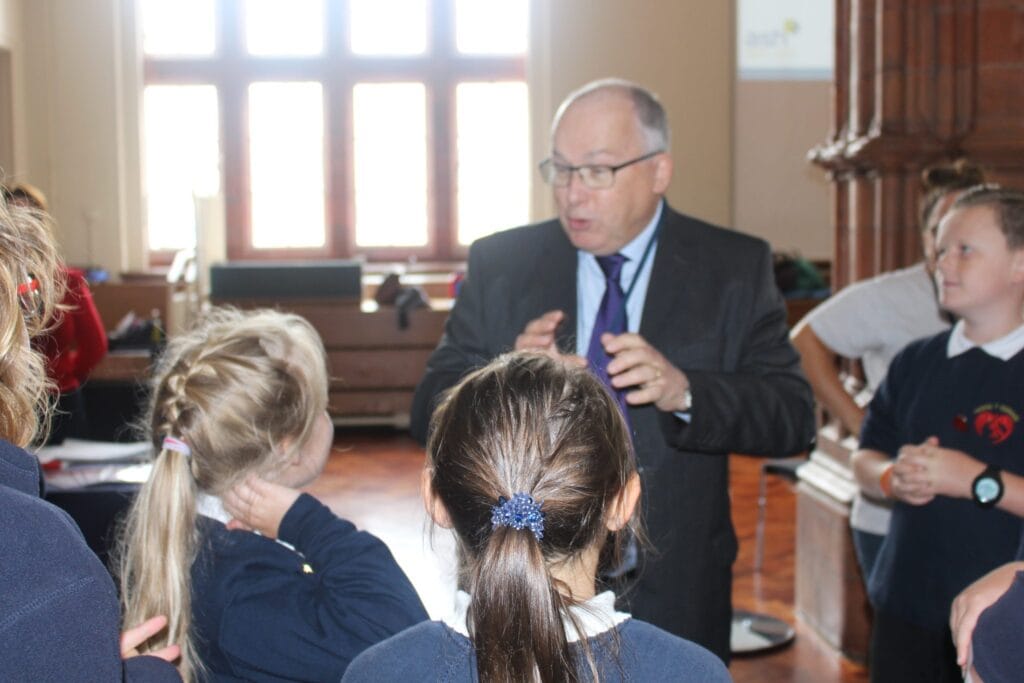
As a former teacher John’s passion in tobacco control has always been about educating children. Through John’s work with the Healthy Schools programme he has ensured the harms associated with tobacco use are firmly on the agenda. In the launch of the new Tobacco Control Action Plan for Wales the Public Health Minister, Rebecca Evans, directly referred to the scheme and its contribution to prevention; promising a review of the tobacco criteria within these national quality awards.

There is much still to be done, smoking prevalence for the unemployed stands at over 40%, 33% of people with mental ill health are still smoking and 16% of women smoke throughout their pregnancy. But overall rates are falling especially amongst young people with just 8.5 % of teenagers now smoking. This reduction is something to be proud of.

John will be sorely missed at ASH Wales and we will be forever in his debt for the contributions that he has made and the changes he has supported. We wish him well and hope that he enjoys continuing to follow our work as we continue the fight for a smoke-free Wales.

Suzanne Cass, Chief Executive Officer of ASH Wales

To find out more about what has happened since the smoking ban  visit www.ash.wales.

Survey reveals lack of awareness around the environmental impact of cigarettes

New findings from a survey carried out for Keep Britain Tidy to mark the launch of its #BinTheButt campaign reveal that less than half of smokers know that cigarettes contain plastic.

The survey also reveals that one in ten smokers do not consider cigarette butts to be litter, 22 per cent don’t know that putting a cigarette down the drain causes problems to the environment, and ten per cent think cigarettes are biodegradable.

Cigarette butts are made from plastic fibres which means they pose a major threat to marine life and it can take up to 12 years for them to decompose.

Arsenic, lead and nicotine are just some of the harmful chemical ingredients used to make the cigarette filters. Meanwhile toxins from the tobacco residue in the butts pollutes the waterways and endangers animals that ingest them.

Cigarette butts are the most littered item in the world and ASH Wales is spearheading a campaign for local action to prevent this toxic polluting the environment.

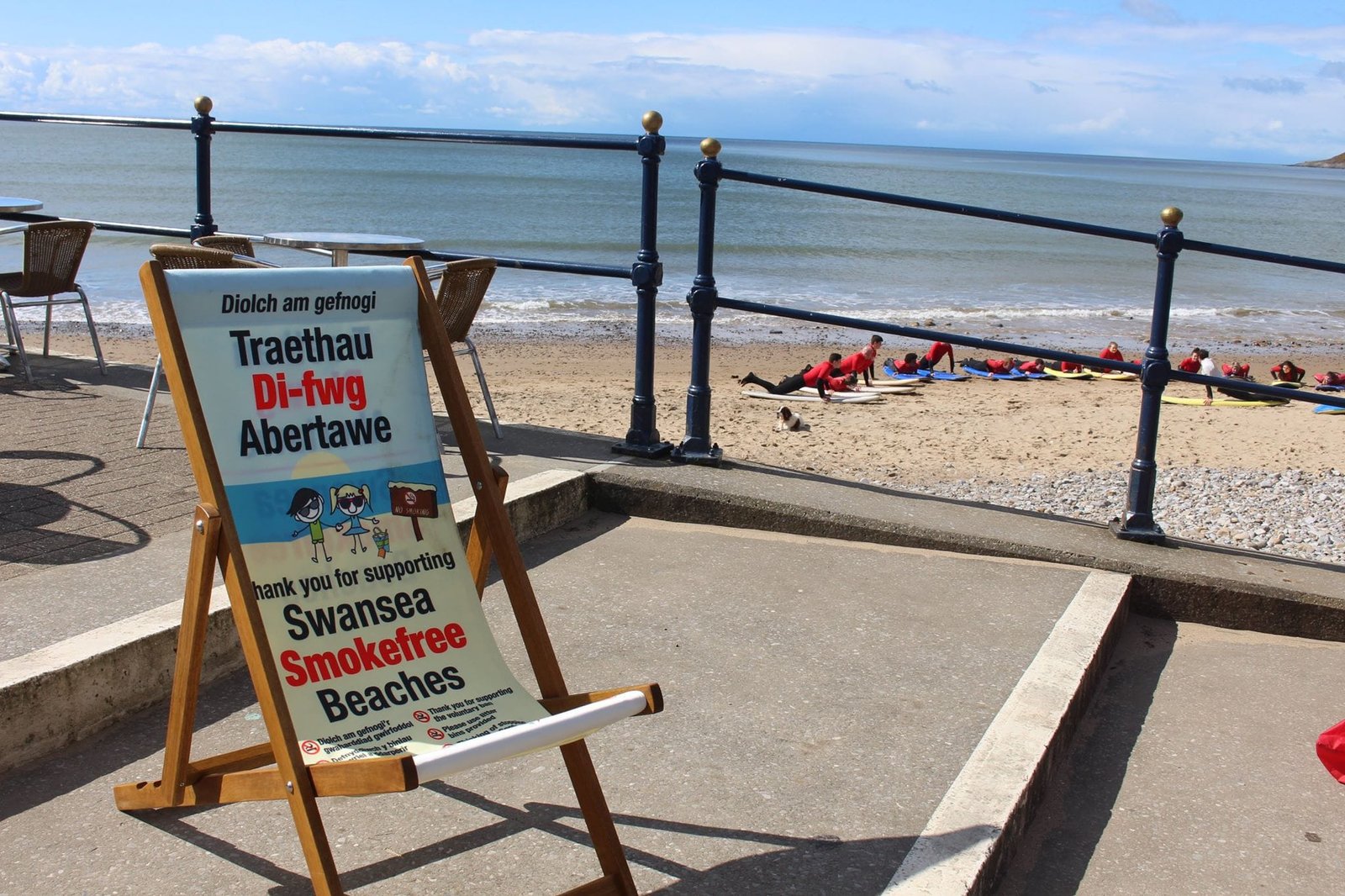
Ash Wales has been calling for local authorities across Wales to ban smoking on beaches to help reduce litter. So far three beaches have put a voluntary smoking ban in place, Caswell Bay and Langland Bay in Swansea and Little Haven in Pembrokeshire, and it is hoped more will soon follow suit.

There is widespread public support for the ban. In a recent survey 61% agreed with banning smoking in communal recreational spaces, such as parks and beaches.

Suzanne Cass, Chief Executive of ASH Wales, said: “Everyone knows smoking is bad for your health, but not many people are aware just how bad it is for our environment, wildlife and waterways – especially our picturesque beaches.

“In just one hour, children from Llantwit Major Primary School collected 300 cigarette butts. This goes to show the massive scale of the problem, even in small areas.

“By bringing down smoking rates and getting smokers to put their butts in the bin we will help reduce the litter problem which is plaguing our beautiful country.

A Keep Wales Tidy report published in July showed that cigarettes are the most littered item in the country with cigarette butts found on 80.3 per cent of Welsh streets.

The findings from the Keep Britain Tidy survey show the need to educate people about the real impact of these discarded cigarette butts.  Ash Wales welcomes the launch of the #BinTheButt campaign which aims to raise awareness about the environmental consequences of discarding cigarettes in the wrong places.

Mark Child, Cabinet Member for Care, Health and Ageing Well, who backs Ash Wales’ Smoke Free Beaches campaign added:

“We have all become very aware recently about plastic pollution in the environment, particularly the sea, its damage to wildlife and the food chain, the quality of our experience of nature and the outdoors, and ultimately our health. The plastic from cigarette butts stubbed out on beaches mainlines straight in to the sea around our coast. There are lots of reasons not to smoke on the beach, here in Wales or on holiday, and damaging our beautiful coastline and all its wildlife is a very good one, I support #BinTheButt. I am delighted that designating two beaches in Swansea smoke free has led to a marked decrease in butts in the sand and in the water.

To find out more about ASH Wales’ Smoke Free Beaches campaign and about how you can access help to give up smoking visit www.ash.wales.

Stop smoking and you’ll be 32 per cent less likely to develop vascular dementia, claim scientists

The latest report from a team of Korean scientists linking smoking to an increased risk of developing dementia makes alarming reading.
According to the researchers from Seoul National University smokers have a 20 per cent greater risk of developing dementia in later life than non-smokers.

The study followed the lives of 46,140 men aged over 60 for 11 years and found that the non-smokers among them had a 19 per cent lower risk of suffering dementia and a 29 per cent lower chance of developing vascular dementia.

However, the report, which was published in the Annals of Clinical and Translational Neurology, also highlights the enormous benefits of quitting smoking and offers new hope to those planning to kick the habit.
While it highlights the risk of developing dementia it also shows that stopping smoking can significantly lower that risk, even for long term smokers.

The scientists found that those who smoked but recently quit had a 14 per cent lower risk of developing Alzheimer’s in later life.  Quitters also had a 32 per cent reduced chance of developing vascular dementia.

As quoted in the Sun newspaper, Dr Sang Min Park of Seoul National University in Korea, said: “Smoking cessation was clearly linked with a reduced dementia risk in the long term, indicating that smokers should be encouraged to quit in order to benefit from this increased risk.”

The links between smoking and the risk of developing dementia are well established. The World Alzheimer’s Report 2014 looked at the findings from 14 studies and found a statistically significant increased risk of dementia in current smokers compared to those who have never smoked. Meanwhile the 2017 Lancet Commission on dementia risk listed smoking as one of the nine modifiable risk factors behind the condition. According to the Alzheimer’s Society, other reviews have estimated that smoking carries with it a 30 to 50 per cent increased risk of developing dementia.

If you are a smoker and would like to quit, ASH Wales offers great tips on how to get started.  Visit the ASH Wales website www.ash.wales to get friendly advice from other quitters as well as daily tips and motivation.  Help Me Quit is run by NHS Wales and will help you to find the stop smoking service that best suits you.  Contact them on 0808 278 6119 or visit www.helpmequit.wales

ASH Wales Welcomes MP’s Calls for E-Cigarettes to be Embraced as a Cessation Tool

The Westminster Select Committee report published today (17/08/2016) states the UK “Government is missing an opportunity with e-cigarettes” to help smokers quit.

The report says there is clear evidence e-cigarettes are substantially less harmful than conventional cigarettes and should not be treated in the same way.

It calls for an improved process to speed up the licensing of e-cigarettes as medicines which could support the switch from smoking to vaping for thousands of would-be quitters.

ASH Wales Chief Executive, Suzanne Cass, said: “We hope Welsh Government and key policy makers will take note of these findings. It is essential that smokers are given access to the full range of quit smoking products and that health care professionals are fully informed about the harms and benefits of using an e-cigarette.

“We must do all we can to ensure smokers are made aware of the evidence that e-cigarettes are significantly less harmful than cigarettes and are a viable and less risky alternative to smoking. The licencing of e-cigarettes could help inform public opinion and make it easier for medical professionals to be able to recommend the use of this product and significantly help those on low incomes and with high levels of addiction.”

The report also states that concerns about the risk of e-cigarettes potentially providing a ‘gateway’ into conventional smoking have not materialised to any significant degree. Similarly, the risk of the variety and type of flavours being attractive to young non-smokers, who would be drawn into e-cigarette use, also appears to be negligible.

However, ASH has some concerns over calls in the report for a review of the advertising restrictions which would potentially allow the tobacco companies to place adverts for e-cigarettes inside cigarette packs. ASH believes the control of any such advertising should be created by public health professionals rather than the tobacco industry.

George Butterworth, from Cancer Research UK, said any changes to current e-cigarette regulations “should be aimed at helping smokers to quit whilst preventing young people from starting to use e-cigarettes”.

A recent study in Wales, published in the BMJ, showed that the experimentation with e-cigarettes amongst young people is on the increase, however regular use remains low. The report also found the vast majority of weekly smokers who had tried tobacco and e-cigarettes reported they tried tobacco before using an e-cigarette.

ENDS

Notes for editors

References:

https://www.parliament.uk/business/committees/committees-a-z/commons-select/science-and-technology-committee/news-parliament-2017/e-cigarettes-report-publication-17-19/

https://bmjopen.bmj.com/content/7/2/e012784

Swansea’s Langland Bay Goes Smokefree in Rolling Programme to Improve Beaches

One of Swansea’s most visited coastal bays has become Wales’ third smokefree beach.

Langland Bay, a Blue Flag and Seaside Awards-winning site, will be the second beach in Swansea to have a voluntary smoking ban in place. Swansea Council launched a successful pilot ban at Caswell Bay in 2016, which resulted in a reduction in litter levels across the area,

Cigarette butts are the most littered item in the world and can take up to 12 years to decompose as they are made from plastic fibres. Toxins from tobacco residue in the butts pollutes waterways and poses a danger to animals who often mistake them for food.

Swansea and Neath Port Talbot have some of the highest smoking rates in Wales. On average 19% Welsh adults smoke, however, in Swansea this is 20% and neighbouring Neath Port Talbot has the highest rate in the country at 24%.

Mark Child, Cabinet Member for Care, Health and Ageing Well, said: “The launch of a smokefree beach at Caswell Bay has been a great success.

“There has been a noticeable reduction in cigarette litter at the beach which tells us that those visiting the beach are getting on board with the health campaign, and the beach environment has improved.

“The aim is to encourage adults not to light-up at the beach because of the damage it does to health and the potential bad habits it might encourage children to get involved.

“We don’t have powers to ban smoking at beaches. This is a voluntary initiative where we are asking the public to support it.

“We now feel we are able to look at rolling out smokefree beaches at other locations and Langland Bay is a good place to start.”

Suzanne Cass, Chief Executive of ASH Wales, said: “Beaches should be a clean, smokefree place for everyone to play, take part in sport and enjoy, so moving smoking away from our beaches is a step in the right direction.

“We surveyed 125 school children on Swansea Bay beach last week and 88% said it makes them sad to have adults smoking near them, and worryingly 88% also said they thought smoking was common”

“Shockingly almost half of long-term smokers become addicted before leaving high school and this is why it is so important we protect children from second-hand smoke and ensure they see less people smoking.”

Last week Swansea Bay beach played host to Ospreys in the Community and 350 primary school children who helped launch a Smokefree Sport initiative, supported by tobacco control charity ASH Wales.

Ospreys First Welsh Sports Team to Back Smokefree Sports Campaign

Ospreys in the Community have become the first team in Wales to throw their weight behind a national smokefree sports campaign.

The ASH Wales campaign aims to promote no smoking at sports events and will be launched in front of hundreds of school children at the Swansea Bay Beach Tag Festival today (26th June).

The majority of Welsh stadiums are already smokefree zones but many grounds and fields where children train and play have yet to follow suit. The youth sports day is the first major event in Wales to support the smokefree sports initiative.

Ospreys in the Community will be working with tobacco control campaign charity ASH Wales to encourage regional clubs to adopt a smokefree policy to protect young players from the influence of smokers.

More than 600 local primary children are expected to attend the annual festival which is designed to promote healthier lifestyles through outdoor activity and playing sport.

Suzanne Cass, Chief Executive of ASH Wales, said: “Research shows young people are highly influenced by others smoking around them. Children with a parent who smokes are 70% more likely to take up the habit and shockingly almost half of long-term smokers begin smoking before leaving high school. We need to do everything we can to ensure that children see less smoke in the world around them and do not take up this deadly habit.”

Clive Oliver, Schools and Clubs Community Officer from Ospreys in the Community, said: “Tobacco and sport just don’t mix. Ospreys in the Community aims to harness social good and empower positive life choices. There is no doubt going smokefree is one of the healthiest messages a sporting club can share with its community.”

“Reducing exposure to smoking amongst young people is the key to reducing uptake. With over 600 children in attendance at the Ospreys beach rugby festival, it’s a prime opportunity for young people to be supported not to smoke and encourage further smokefree sports environments across Wales.”

Swansea and Neath Port Talbot have some of the highest smoking rates in Wales. On average 19% Welsh adults smoke, however, in Swansea this is 20% and neighbouring Neath Port Talbot has the highest rate in the country at 24%.

Kimberley Martin, Campaign Co-ordinator at ASH Wales said: “Outdoor smokefree areas make smoking less visible and less socially acceptable whilst providing a healthy family-friendly environment. Adopting a smokefree policy is about making children’s wellbeing a priority and promoting healthy choices. We would like more sports clubs across Wales to become smokefree and to follow the lead of Ospreys Community Rugby.”

Swansea has already adopted some progressive smoking policies, declaring Caswell Bay a smokefree zone in 2016, one of only two beaches in the UK to have a voluntary smoking ban in place.

To coincide with the event, ASH Wales are running a poster competition for primary school children with the top prize being a signed rugby ball courtesy of the Ospreys. For more information, head to twitter.com/ASHWalesCymru