



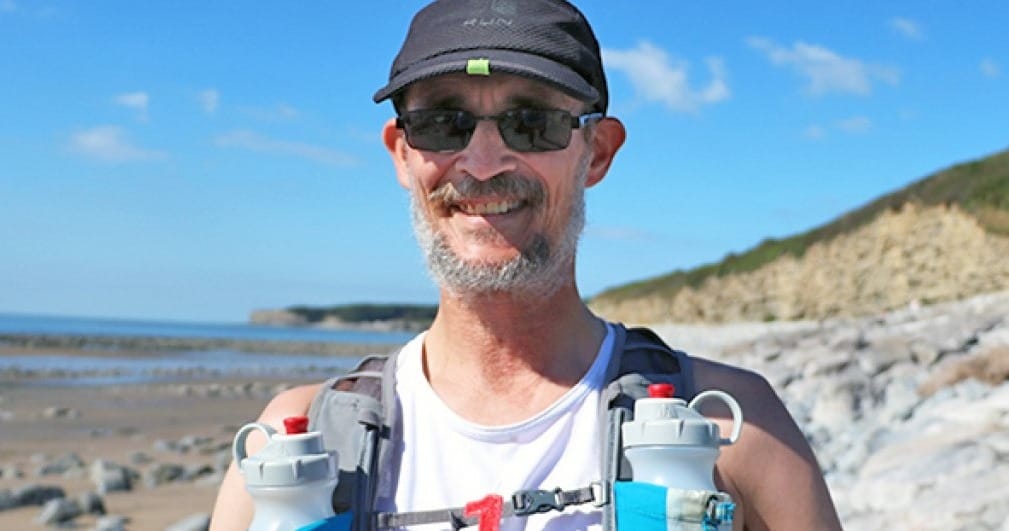



John Dicey is Global CEO & Senior Therapist for Allen Carr’s Easyway to Stop Smoking method. After quitting smoking, having smoked 80 cigarettes a day, John Dicey was inspired to help others do the same. He was trained by the late Allen Carr in 1998 and went on to treat more than 30,000 smokers face to face. John and Allen worked with smokers in 50 countries and worked on a series of books together which have sold 16 million copies worldwide. This is John’s story.
I was the worst smoker on the planet. I know that sounds like an empty, albeit embarrassing boast – but I really was. Most days, without fail, even when I was under the weather, I’d puff my way through at least 80 cigarettes. Quite how I managed that is a mystery. I was a chain-smoker. No sooner had I stubbed one cigarette out – I’d have lit another – frequently ending up lighting a new cigarette while the previous one was coming to an end. I was ashamed of it then, and even now it makes me feel deeply embarrassed. Cigarettes, nicotine, had a deathly grip on me. 
For years I’d tried to quit. I used every method under the sun. Patches, gum, hypnotherapy, aversion therapy, Chinese remedies, herbal remedies, acupuncture, and even shock treatment (a guy showing me photos of smokers’ lungs, illnesses, and diseases yelling at me to quit) – nothing worked. Not even for a day!
Being a chain-smoker is really tough – I used to buy my cigarettes at different shops each day – on a rota system because to buy 4 packs, every day, in the same shop would be hugely embarrassing. If I was going to a party I’d take at least 4 packs with me just for the evening. Less committed smokers didn’t seem to mind running out of cigarettes and cadging off other smokers – but I could never risk that myself…and in fact, I’d always take into account those smokers (who would cadge) in my calculations for how many packs of cigarettes to take myself.
All my attempts to quit smoking ended in abject failure and on the rare occasions that I would manage to quit for a few hours – it would be utter torture and hell.
The first time I attended an Easyway seminar I remember Allen saying that it was easy to stop smoking and thinking “you’ve got to be kidding me!”.
I’d only actually agreed to go to the seminar at my wife’s suggestion on the basis that she promised, if it didn’t work, she’d stop hassling me about my smoking for a year. Even when I left the seminar I couldn’t believe it was going to work. But I thought I’d give it a go as I had nothing to lose (and in any case, I was fully intent on getting my money back under his money back guarantee).
After the seminar I recall making it a hundred yards down the road without feeling inclined to seek out the nearest shop that sold cigarettes, and feeling slightly suspicious of my lack of interest in doing so.
By the time I’d driven home, past countless petrol stations, newsagents, and convenience stores, without pulling over to buy 80 Rothmans cigarettes – I was amazed. The only difficulty I seemed to have was accepting that it was true. That I didn’t want to smoke. I felt that mild sense of “wow, this is a bit weird” for a while and that was that.
I think it was my curiosity, how on earth could something that seemed impossible and unpleasant in the past, now appear to be so simple, combined with an overwhelming feeling that if I could quit, anyone could, that stayed with me for the following months and eventually compelled me to contact Allen to ask if I might be able to get involved.
My predecessor as CEO, Robin Hayley (now Chairman of Easyway) and Allen seemed interested in my ideas, impressed by my business background, and enthralled by my passion and enthusiasm. I was delighted when they eventually invited me on board. I sold my business interests in the hospitality industry and undertook to train as an Allen Carr’s Easyway Therapist.
 It was a long and arduous process. The method is made up of 3 seminars. One is 5 hours long, and the other two are 3 hours long. They are mainly monologues – designed to guide groups of smokers through the principles of the method. The task of getting into a position whereby you are able to deliver the seminars, with real live smokers – often interrupting, questioning, and challenging you – is something that only a trained Allen Carr Therapist can really appreciate. I practised and practised and practised and eventually I knew I was ready.
Helping people to quit smoking face to face was the most thrilling, enjoyable, and exhilarating experience of my life.
As we succeeded in growing our publishing interests and seminar business to be a truly global operation (in more than 50 countries worldwide) it was my privilege to pass on the training Allen provided to me, to trainee therapists in places as diverse as Greece, Serbia, Japan, New Zealand, South Korea, Chile, Guatemala, Iceland, Israel, Saudi Arabia, Lebanon, and Russia to name just a few.
As Global CEO, once a year, I invite our managers and therapists from all 50+ Allen Carr countries to join me for 3 days at a hotel near London. It’s my favourite week of the year where we exchange ideas, inspiration, best practise, and almost as importantly, have a huge humdinger of a party. As we grew and grew I was worried that we’d lose our sense of “family”, but so far – so good, we remain a group of people, joined together, with a common objective; to cure the world of smoking. And it’s not just smoking – over the past 10 years we’ve successfully applied the method to many other problems including alcohol, weight issues, sugar addiction, gambling addiction, and this year – technology addiction, with our new book ‘Smart Phone, Dumb Phone’. Ensuring that Allen Carr’s legacy achieves its full potential is an honour and privilege for me, not to say, a huge motivation.
To find out more about Allen Carr’s Easyway method, click here.

 Robert West, Professor of Psychology at University College London and author of The Stop Smoking Formula, shares his top tips on how to quit, staying strong and coping with cravings.
 So the secret of stopping smoking is to keep your resolve strong and to what you can to avoid or minimise the urges. The best way to keep your resolve strong is to change your mind set – you have to become an ex-smoker in the very core of your being. You have a new identity as someone who used to smoke but you simply don’t do that any more. You would no more smoke a cigarette than you would hit someone who has annoyed you or rob a bank. You are not that kind of person. And the reason is that you realise that it is a stupid waste of money and is killing you. Even if you have enjoyed it in the past, those days are gone. So, when someone offers you a cigarette your answer is ‘No thanks, I don’t smoke any more’, not ‘No thanks, I’m trying to stop’.
 What about the other side of the equation? The urge or desire to smoke. A lot of smokers think that this comes from the way smoking helps with stress, or the need to have something to do with their hands. Neither of these are true, and it’s easy to show this.
 So, how to reduce the urge to smoke? There is a prescription drug that does this very well. It is called Champix in most parts of the world and Chantix in the US. It is a pill that you take twice a day and it is like an appetite suppressant for ‘nicotine hunger’. It works by attaching itself to parts of brain cells that nicotine would normally attach to and stimulating them just a little bit but also blocking them so that nicotine can’t get on them. You take it for 12 weeks, or longer if it takes you a week or two to stop smoking completely. As with all drugs, there are side effects. The common ones are feeling sick and having difficulty sleeping. These usually subside over time. Some people taking this drug have experienced suicidal thoughts or become aggressive but research with hundreds of thousands of users of the drug have failed to show the drug to be causing these symptoms and they are probably (though not definitely) caused by something else.
 So to stop smoking the goal is to keep resolve high and minimise urges to smoke. There are lots of ways of doing this and some will work better with some people than others. Going to see a qualified stop-smoking practitioner can help you decide what method will work best for you. They will also be able to give you that extra resolve you might need, make sure you are using your medication or nicotine product to best effect and help you deal with any unforeseen problems you might encounter. In Wales, getting to see a practitioner is really easy. Just call Help Me Quit on 0800 085 2219 or
 You may think smoking just five cigarettes a day isn’t making a dent in your finances.
 10-a day-smokers spent £156 a month on cigarettes. That’s enough for a romantic weekend getaway, a wardrobe upgrade, gym membership or a new bike.
 Smoking 20-cigarettes a day is costing you a fortune – £3796 a year to be precise. On a weekly basis, you’re wasting £72 on cigarettes and in a month, £312.




 If you smoke you are at a greatly increased risk of developing problems with your heart and blood circulation, such as coronary heart disease and stroke. Smokers are almost twice as likely to have a heart attack as non-smokers.
 Smoking is the leading cause of lung cancer which is the greatest cause of cancer related deaths worldwide. More than four in five UK lung cancer cases are caused by smoking. It is also responsible for a range of debilitating respiratory diseases including chronic obstructive pulmonary disease (COPD), pneumonia and asthma. Second hand smoke leads to deaths from asthma, lower respiratory infections and lung cancer, particularly in children exposed to smoke.
 Smoking prematurely ages your skin by between 10 and 20 years. You’re three times more likely to develop
  Researchers have found that smoking does long term damage to the structure of the