Scamp the sniffer dog uncovers illegal tobacco haul in Powys

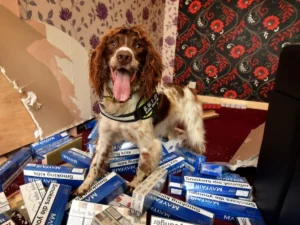
Scamp, Wales’ top sniffer dog, has uncovered a stash of hidden illegal tobacco in Powys during a crackdown by Trading Standards officers.

Acting on Intelligence, Powys Trading Standards working with Dyfed Powys Police and BWY Canine uncovered the counterfeit tobacco concealed at premises in Powys.

Earlier this year ASH Wales reported on how  Scamp is so successful at sniffing out illegal tobacco that he has had a £25,000 bounty put on his head by an organised criminal gang.

Illegal tobacco remains a major problem in Wales, making up 15% of all tobacco sales in the country and undermining tobacco control policies aimed at reducing the number of those that smoke. There are fears too that the trade in illegal tobacco could be funding organised crime both here in Wales and throughout the United Kingdom

Cllr James Evans, Cabinet Member for Trading Standards, said: “Combating the supply of counterfeit and illegal tobacco is one of our ongoing priorities of our Trading Standards Service. We are looking to increase the understanding of the impact it has amongst smokers and local communities when shadow activities occur with illicit products.

“Operations of this nature, should also serve as a warning to those involved in the supply and sale of illegal tobacco that we will take the appropriate action with partners that is necessary to combat this problem.”

Clive Jones, the council’s Professional Lead for Trading Standards, Community Safety and Emergency Planning added: “This illegal trade harms legitimate traders in Powys and wider afield. Over the past two years we have seized nearly 60,000 illegal cigarettes and 60kg of illegal tobacco as part of our overarching operation on illicit products, named Operation Date. Investigations are ongoing.

“The supply of illegal tobacco bypasses government tobacco control measures, such as not selling tobacco to children and availability of illegal tobacco is increasing. This makes it more likely that youngsters will start smoking and we find that counterfeit products often contain high levels of heavy metals such as cadmium.

“Our surveillance on illegal activity involving counterfeit products of any variety is increasing and we ask users or any person offered suspected counterfeit goods to be vigilant and to warn us of any suspicious sellers through our contact points. Alternatively ring Crimestoppers on 0800 555 111.

“This action would not have been possible without the support of Dyfed Powys Police and we wish to thank officers from operational policing team and intelligence units and support agencies such as BWY Canine”

Suzanne Cass, Chief Executive Officer of ASH Wales, said: “We applaud the efforts of all those involved in operations of this nature and hope this sends a message to others that this activity will not be tolerated.

“Illegal tobacco currently makes up 15 per cent of all tobacco sales in Wales – the highest level in the UK – and continues to undermine efforts to tackle smoking prevalence. Criminals sell illegal tobacco at pocket money prices to those who would not otherwise be able to afford it, disregarding all tobacco control measures.

It represents a major threat to the health of the nation greatly increasing the numbers of those at risk of developing smoking related conditions, which currently contribute to 5,388 deaths and 26,489 hospital admissions a year in Wales.

“It is a crime that threatens lives across Wales and resources must be directed towards helping to stamp it out.

The council’s Trading Standards Service can be contacted on Brecon 01874 623420; Llandrindod Wells 01597 826032; Newtown 01686 617524. Alternatively email trading.standards@powys.gov.uk or visit www.powys.gov.uk/tradingstandards

Smoking is forcing families across Wales further into poverty, charity warns

With cigarettes costing £10 a packet and nearly of quarter of Welsh residents living in poverty, ASH Wales is asking, ‘Who Can Afford to Smoke?’.

This week the tobacco control campaign group will call for action to tackle smoking among Wales’ most deprived communities, where up to a quarter of residents smoke.

It has warned that smoking contributes to the deprivation facing many families across Wales and says that quitting the habit would lift hundreds of thousands of people out of poverty.To find ways of tackling the problem experts from across Wales are gathering at the annual Wales Tobacco or Health Network (WTHN) conference in Cardiff on Wednesday (February 20), which this year is entitled ‘Who Can Afford To Smoke?’.

Currently 24% of people in Wales live in income poverty. Yet despite facing huge financial challenges they are the most likely to smoke, with 28% of those living in Wales’ most deprived areas smoking compared to 13% in the most affluent parts of the country. The lowest rate of smoking is in Monmouthshire at 13% compared to the highest in Neath Port Talbot at 25%.


And the situation shows no sign of changing with the gap in smoking prevalence between Wales’ most deprived and least deprived areas having barely fallen in the past decade.
Meanwhile 43% of unemployed people in Wales smoke – a figure that has risen in the past decade despite increased tobacco control legislation.

Speaking ahead of the event ASH Wales CEO Suzanne Cass said: “Nicotine addiction places a huge financial burden on smokers and it is the most deprived members of our community that are hit the hardest. The high cost of tobacco combined with the power of nicotine addiction means many smokers will prioritise fags over food or fuel or allow their debts to spiral.

“This has a devastating impact on the health and well-being of them and their families, and is a particular concern given the challenges many are facing since the introduction of Universal Credit.

“It is important to emphasise that smoking is an addiction not a lifestyle choice and what is needed is targeted smoking cessation support for those in our most deprived communities who are desperate for help to quit the habit.”

Research carried out by ASH has shown that 28% of those living on the breadline across the UK would be lifted out of poverty if they gave up smoking.
The average smoker in Wales spends more than £160 a month on tobacco with 20-a-day smokers shelling out around £327 a month and £4,000 a year to fund their habit.

ASH Wales calls for smoking in pregnancy to be treated as an addiction not a lifestyle choice

ASH Wales welcomes a report by Cardiff University highlighting how the stigma of smoking in pregnancy can stop women from getting the help they need to quit.

Currently 16% of women in Wales continue to smoke through their pregnancy so, as the report highlights, there is a strong need for smoking cessation services that engage pregnant smokers rather than isolating them.

Indeed, interviews ASH Wales has carried with health professionals working alongside pregnant smokers reinforces the findings that the stigma attached to smoking in pregnancy prevents many women from engaging with smoking cessation services.

However, while it is important to acknowledge the barriers to women seeking help, ASH Wales is concerned that the report portrays smoking as a lifestyle choice and coping strategy for pregnant women rather than an addiction.

The report describes pregnancy as a challenge to women’s ‘independent choices’, including smoking.  Women do not smoke through pregnancy by choice, they do so because they are physically addicted to nicotine – an addiction which can have devastating consequences in pregnancy, ranging from premature birth to miscarriage, stillbirth or sudden infant death.

The idea that pregnant women smoke through choice is contributing to the stigma and sense of shame these women face.  It is crucially important to acknowledge that this is a physical addiction not a choice and must be treated as such by women’s families, loved ones and the health professionals that work with them.

ASH Wales is working with health boards across Wales to find out the best ways of engaging with pregnant smokers and continues to help raise awareness of the impact of nicotine addiction on unborn babies. To find out more click here 

Ground breaking scheme to help employees quit smoking at work praised by ASH Wales

Tobacco control campaign group Action on Smoking and Health (ASH) Wales has praised a manufacturing firm after workers quit smoking thanks to a ground breaking workplace scheme.

It is urging other companies to follow the example of the manufacturing firm Sandvik Osprey which holds smoking cessation sessions run by NHS Wales at its Neath Port Talbot plant.

Sheraine Thomas, who is the Safety, Health, Environment and Quality (SHEQ) Manager at the company, came up with the innovative idea of organising the sessions within the workplace, after becoming concerned about the number of workers who smoke and the effect this was having on their health.

After conducting a survey to find out whether staff would support the idea, she arranged for an NHS Wales smoking cessation advisor to hold group sessions at the company’s site in Neath Port Talbot. Every week the advisor spoke to the group about their progress, measured their carbon monoxide levels using a CO monitor and advised on nicotine replacement therapy to combat cravings.

SHEQ Manager Sheraine, now hopes to see a reduction in the amount of time workers are having to take off due to sickness exacerbated by smoking.

“Stopping smoking strengthens the immune system and I really think it will make a difference to how many people go off work ill,” she said.

“One staff member who took part said he hasn’t had to go the doctors once since he gave up smoking 12 months ago.

“Another employee who quit went on to organise setting up a squash league and asked the SHEQ team to start a weight loss club. It has made a big difference to these people’s lives.”

She said she believes the convenience of staff being able to attend sessions within the workplace and the fact they have been there to support each other’s quit attempts has been a big motivating factor for those taking part.

“The reason why I think it has been so successful is because it is here. The smoking cessation advisor came to the site and ran the sessions every week at the same time. The guys taking part have kept in touch with each other by phone and seen each other on site. One guy told us he’d wanted a fag one day but he and a friend had a chat and they motivated each other to stay on track.”

Mark Grey (pictured above left) who took part in the sessions, successfully quit and now vapes, having previously smoked 20 cigarettes a day – a habit he started at just 14-years-old.

He agrees that having the support of his colleagues helped to spur him along: “It really helped that I was with the boys every week and we kept asking each other how we were getting along and giving each other support.

“I breathed into a CO monitor every week which was really motivating. In the first week my level was 22 and by the second week it was 3. I couldn’t believe it had come down so much in just one week. I do think that more people would give up if they did this in other workplaces.”

He was first motivated to give up for the sake of his children and said that since quitting he no longer craves cigarettes and has taken up going to the gym to relax instead:

“I just thought I’d had a gut full really. I been smoking for 20 years, since I was 14 and I smoked around 20 a day. I’ve got five kids, aged 22 to 4 and I decided to give up for them really.

“I don’t miss smoking and these days I don’t like the smell of cigarettes at all. I don’t have any cravings and I’ve gone back to the gym so that has taken my mind off things. I just feel better in myself generally. I don’t have smoky clothes anymore and less of a cough. I feel brilliant and I’d never go back to smoking.”

Nicholas Cromwell  (pictured above right) works with Mark and gave up after smoking up to 40 cigarettes a day for 22 years from the age of 16.
He too gave up for the sake of his children and says he hasn’t looked back since:

“It was really starting to affect my health. I struggled to play with my kids and would get out of breath even climbing up the stairs. One day my daughter turned to me and said: ‘Daddy when are you going to stop smoking?’.

“I promised her I’d give it a go then on New Year’s Day I had a light bulb moment and thought, ‘that’s it, I’m going to give it a go’.”

He too gave up using a vaporiser and has taken up exercise, training at the gym, cycling with his son and ditching junk food for a healthy diet instead.

Sheraine is now gathering together the next group of quit smoking recruits for sessions due to commence on 27th February 2019.

Suzanne Cass is CEO of Action on Smoking and Health (ASH Wales). She said the success of the scheme at Sandvik Osprey demonstrates the role that employers can play in helping to cut smoking prevalence in Wales as part of their staff wellbeing programmes.

“Smoking costs Welsh businesses around £88.4 million a year and there are numerous benefits to employers of reducing the numbers of workers that smoke – from increased productivity to a greatly reduced levels of sickness absence.

“Only 3.1% of smokers in Wales accessed NHS quit smoking services in 2017/18 which falls far below the Wales Tobacco Control Action Plan target of 5%.

“By making smoking cessation services more easily accessible by providing them in the workplace, these numbers could potentially rocket – especially as our research has shown that 64% of smokers in Wales would like to quit.”

ASH Wales Calls For Review Of E-Cigarette Recommendations In Wales

ASH Wales is calling for a review of recommendations around e-cigarettes in Wales, after a study showed they make quitting smoking easier.[/vc_column_text][vc_column_text css=”.vc_custom_1549021711160{margin-bottom: 0px !important;}”]The study led by Queen Mary University of London tested e-cigarettes and nicotine replacement products (NRT) such as patches and gum on 900 smokers in the first study of its kind.

It found that 18.0% of those using e-cigarettes managed to successfully quit smoking and were smoke free after a year, compared to just 9.9% of smokers using other forms of NRT.

The smokers taking part in the study were attending UK NHS stop smoking services and were provided with the products for up to three months. Each participant also received weekly one-on-one behavioural support and CO monitoring for up to four weeks.

The only previous trial comparing e-cigarettes with other NRT used early forms of e-cigarettes which delivered low doses of nicotine and involved no face to face contact with those taking part.

ASH Wales supports the use of e-cigarettes as a smoking cessation tool, based on clear evidence which shows e-cigarettes are substantially less harmful than conventional cigarettes.

ASH Wales CEO Suzanne Cass said: “Currently 7% of adults in Wales use e-cigarettes – roughly 179,000 people, the vast majority of which are using them to try to quit or cut down smoking.

“Based on these figures there are tens of thousands of Welsh smokers that are yet to try an e-cigarette.

“Health professionals working in smoking cessation have a golden opportunity to promote a product which is both popular and highly effective, as this study shows.

“ASH Wales is calling for a more consistent approach on the part of health professionals when it comes to recommending e-cigarettes as a smoking cessation tool.”

Lead researcher Professor Peter Hajek of Queen Mary University of London, said he believes the results of the study will lead the way for more health professionals to recommend the use of e-cigarettes: “Although a large number of smokers report that they have quit smoking successfully with the help of e-cigarettes, health professionals have been reluctant to recommend their use because of the lack of clear evidence from randomised controlled trials. This is now likely to change.”

Currently in Wales 19% of adults smoke, leading to over 5,000 deaths and 26,489 hospital admissions every year at a cost of £302 million to the Welsh NHS.

Relight your fire by giving up smoking this St Dwynwen’s Day

THIS St Dwynwen’s Day why not ditch the hearts and flowers and give your beloved the gift of a smoke-free life instead.

As a smoker, your habit will endanger the health of those around you and could be a deal breaker in some relationships. Meanwhile research has shown that smoking is a major turn-off for prospective partners, with a survey carried out by oxygen therapy provider Inogen last May finding that 70% of women are put off by those who smoke and 56% would not consider dating a smoker. Of the men that were surveyed 46% said they wouldn’t date a smoker and 65% said they found smoking unattractive.

An earlier survey by the Department of Health carried out in 2012 found that around half of respondents would think twice about starting a relationship with a smoker.
At the time, the relationship website eHarmony.co.uk said 81% of its members said they would not want a heavy smoker as a partner. Meanwhile at Match.com 72% of male members and 73% of female members said they wanted a non-smoking partner.
If your partner agrees that smoking is the ultimate passion killer, here are a few reasons why stubbing out your cigarettes could relight your fire this St Dwynwen’s Day.

An unhealthy habit ?
There are numerous health risks associated with smoking. Smoking results not only in coughs, colds wheezing and asthma but fatal conditions such as pneumonia, emphysema and lung cancer. Around 84% of deaths from lung cancer and 83% from chronic obstructive pulmonary disease are caused by smoking.
Smoking also causes major damage to the heart, increasing the risk of coronary heart disease, heart attack, stroke, peripheral vascular disease and cerebrovascular disease. Nicotine and carbon monoxide from smoking puts a strain on the heart leading to a higher risk of blood clots. Other chemicals in cigarette smoke damage the lining of the coronary arteries and double a smoker’s risk of having a heart attack. Other cancers linked to smoking include head and neck cancer, stomach cancer and kidney cancer.

Second hand smoke ?
When you smoke it’s not just your health that is affected. Second hand smoke poses a serious health risk to those around you, particularly children. Research has shown that exposure to second hand smoke raises an infant’s risk of lower respiratory tract infections by around 50%. Meanwhile adult non-smokers have a 20 to 30% of developing lung cancer and a 25 to 35% higher chance of coronary heart disease if they are exposed to second hand smoke.

Smoking in the home ?
Did you know that 80% of cigarette smoke is invisible and continues to linger in the home for up to five hours after a cigarette has been extinguished? And because cigarette smoke is made up of particles smaller than household dust it moves easily, spreading its poison from room to room.
Third hand smoke is the tobacco residue left behind after smoking, which builds up and stains surfaces and furnishings. It can be easily ingested by children who put their hands in their mouths after touching contaminated surfaces. Smoking also poses a major fire risk in the home with somebody dying from a fire caused by a cigarette every three days in the UK.

Bad teeth ?
The nicotine and tar in cigarettes causes smokers’ teeth to become stained yellow or brown and can lead to gum disease and tooth loss. Not surprisingly too, many smokers also suffer from bad breath

Money ?
Smoking is an expensive habit with 20-a-day smokers forking out around £56 a week and £243 a month on cigarettes. Even those who smoke 10 cigarettes a day face a hefty shopping bill at £120 a month and £1,460 a year. For those addicted to cigarettes, smoking can exacerbate existing financial problems, leading to debt and a lower quality of life.

If you would like to give up smoking NHS Wales’ Help Me Quit service can find the smoking cessation support that will suit you best. Contact them at 0800 085 2219 or click here.

You may find it easier to quit if you have the support of others in the same boat. Our friendly Facebook group Quit Smoking (Wales), provides the opportunity to share your experience of quitting with both smokers and ex-smokers. Join the group here.