



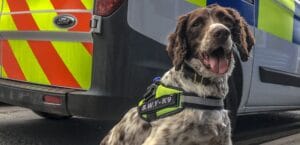
Wales’ top tobacco sniffer dog faces death threats from criminal gang

Meet Scamp, the elite tobacco sniffer dog who is so successful that his owner claims smugglers have put a price on his head.

During his five-year career, the springer spaniel has sniffed out £6 million worth of illegal tobacco, thanks to his powerful sense of smell and natural hunting instincts.

Owner Stuart Phillips who runs B.W.Y Canine in Pembrokeshire, says Scamp’s success rate at sniffing out illegal tobacco hauls means he poses a big threat to the criminals who smuggle in and sell the goods.

“We had to stop working in one part of the country last year, because there was a £25,000 bounty put on his head,” said Stuart.

“It was believed to be linked to an organised crime group and the relevant authorities were informed. I’ve also had death threats, my windscreen has been smashed and my tyres slashed,” he added.

“It’s understandable really, when you’re upsetting some really nasty people.”

Stuart trains specialist detection dogs to sniff out tobacco, firearms, drugs, explosives, meat and even human remains and works with more than 100 local authorities across the UK.

He says the scale of the illegal tobacco industry is vast with products smuggled in from as far afield as China or Russia and sold from shops or homes across Wales.

“It is a massive problem in terms of the volume available and the fact that it’s so readily available in shops. It’s available on social media, through Facebook, and in Wales we have what are generally called fag houses, people selling from their houses. Some of these people have been selling from their houses for years. They’re known throughout their communities for selling cheap cigarettes and cheap hand rolling tobacco.”

The cigarettes are sold at what Stuart describes as ‘pocket money prices’ making them readily available to children and to smokers who would not otherwise be able to afford them.
Even more disturbing however is their link to serious organised crime, with those buying illegal cigarettes often unwittingly funding the activities of organised crime groups.

“The public are not fully aware of what illegal tobacco is linked to,” said Stuart. “They are not just buying cheap cigarettes and cheap hand rolling tobacco. It has knock on effects with other criminality. Illegal tobacco is linked to drugs, to firearms, it’s linked to people trafficking and child sexual exploitation.”

In a special report by BBC Wales earlier this month, Trading Standards officers called for a government taskforce to tackle the problem, warning that criminals selling illicit tobacco target Wales due to a lack of investment in enforcement. New figures show that since 2013 150,000 illegal tobacco products have been seized in Wales.

Stuart whose dog YoYo has sniffed out £4.5 million worth of tobacco since he began work in 2014 is now training the next generation of sniffer dogs, using his tried and tested methods.
“Spaniels are especially good at being sniffer dogs because they have traditionally been used for hunting,” said Stuart.

“Their natural instinct is to sniff out birds and rabbits. Some days we could be searching five or six shops with each search taking around 25 minutes. We need dogs that are capable of doing that work day in, day out. These dogs are made to work, they are not made to sit around on a sofa all day.

Stuart trains the dogs to use their sense of smell starting off with games of fetch using a rubber toy. The next stage of the training is Odour ID Testing where the whole toy is hidden in one of a row of metal containers. The dog has to find the one that contains the toy and learn to give the handler an indication that it has found it. After that the dog must find increasingly small fragments of rubber from the toy and learn not to be distracted by decoy objects. It then progresses to sniffing out cigarettes.

An experienced dog like Scamp can find the tiniest fragment of rubber and everything from a single cigarette to a whole pallet load. He has also been trained to sniff out bank notes and has uncovered wads of cash worth up to £60,000.

He is the best weapon the authorities have in the war against illegal tobacco – a war Stuart says the authorities are a long way from winning: “My work load is huge. There’s not enough days in the week because it’s a massive problem,” he said.

A survey carried out by ASH Wales in 2014 revealed that up to 15% of all tobacco sold in Wales – around 1 million cigarettes a day – is illegal, the highest level in the UK. Meanwhile 45% of all smokers in Wales have been offered illegal tobacco and 70% of buyers agreed that it allows them to smoke when they can’t afford it.

END

Editor’s Notes
Enquiries:
Diana Milne, Communications Officer, ASH Wales 02920 490621 or 0781 851 8567 diana@ashwales.org.uk
Beth Mahoney, Marketing and Communications Manager, ASH Wales 02920 490621 beth@ashwales.org.uk

ASH Wales welcomes plan to tackle obesity in Wales

ASH Wales has welcomed the launch of Wales’ first strategy to tackle obesity – praising the government’s focus on the nation’s health and well-being.

As an organisation campaigning for tobacco control policies to reduce smoking prevalence in Wales, ASH Wales supports any efforts to tackle preventable diseases by helping to change people’s lifestyles.

The Welsh Government’s consultation Healthy Weight: Healthy Wales sets out a 10-year plan to reduce obesity in Wales amidst warnings that obesity could overtake smoking as a leading cause of preventable disease in the country.

Like obesity, smoking prevalence is linked to inequality, with the highest rates being in the country’s most deprived areas.  ASH Wales is calling for a targeted strategy to tackle both smoking and obesity and the links to inequality.

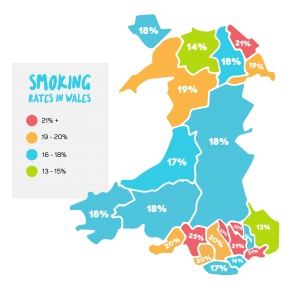
Smoking is the single biggest driver of health inequalities in Wales where 19% of the adult population smoke, a fifth of the population.  Smoking rates in the most deprived areas of Wales stand at 28% compared to 13% among the least deprived adults.

Across Wales lung cancer is the most common cause of cancer deaths – there were 1,891 deaths from lung cancer in 2017 and it accounted for over two in every 10 cancer deaths – more than bowel and breast cancer combined.

ASH Wales CEO, Suzanne Cass, said:

“We support all efforts to improve the health and well being of  the nation and welcome the launch of a strategy to tackle obesity, in particular among children.

“ASH Wales campaigns not just to reduce smoking prevalence but to prevent future generations from taking up the habit by lobbying for tobacco control policies that help to de-normalise smoking.

“Strategies for tackling both smoking and obesity and protecting the health of future generations must be included in all Welsh Government health plans.”

Could Dry January help you to quit smoking?

For many smokers, drinking and lighting up a cigarette go hand-in-hand, which is why Dry January could be the golden opportunity to quit. We asked Andrew Misell, Director for Wales, Alcohol Change UK, about the relationship between drinking and smoking and why the two habits often feed off each other.

What is the relationship between smoking and drinking alcohol. Do smoking and drinking tend to go hand-in-hand?

Smoking was at one time very much rooted in pub culture, and people would expect to be able to smoke whilst out drinking. All that’s changed over the last ten or so years, but alcohol and tobacco still go hand-in-hand for a lot of us. People who drink heavily are more likely to smoke, and smokers tend to drink alcohol more often and more heavily than non-smokers.

How can drinking make it more difficult for smokers to give up?

There is some evidence that people who drink alcohol find it more difficult to quit smoking than those who don’t drink. One reason for this is probably that alcohol makes us less cautious and less inclined to stick to commitments or worry about consequences. We may also be in the habit of drinking and smoking at the same time, and so having an alcoholic drink may feel like a ‘trigger’ to have a cigarette.

Does the social side of drinking affect smokers’ ability to give up cigarettes?

If you’re part of a social group that tends to drink and smoke together, that can make it harder to avoid smoking. It’s a tricky one, because no one wants to ditch their mates in order to improve their health. In the end, it’s a matter of self-confidence – making clear to your friends that you’re cutting back or giving up, that it’s no judgement on their smoking or drinking habits, but that they need to support you in your choices.

Why is Dry January a good opportunity for smokers to consider giving up their habit?

The main aim of Dry January is to encourage those of us who drink to take a pause for thought – to reset the clock on our drinking. Some smokers might think that dealing with one thing at a time is plenty to be getting on with. Trying to stop smoking and drinking in the same month might seem like a bit too much all at once. On the other hand, Dry January could provide you with a chance to think about whether your smoking and drinking habits are feeding off each other and about whether drinking is undermining your will to quit smoking.

Could you summarise the combined health benefits of giving up smoking and drinking?

Both smoking and drinking increase the chances of developing various forms of cancer, and taken together they make the risk of illness even higher. One obvious example is liver cancer, which is a particularly high risk for anyone who drinks and smokes. Cutting back on drinking and giving up smoking will reduce your cancer risk and improve your general cardiovascular health – reducing your risk of a heart attack or a stroke.

To sign up to Dry January click here. Sign up to the Dry January app here

If you are a smoker who would like to quit, there is support available from NHS Wales’ Help Me Quit service. Contact Help Me Quit on 0800 085 2219.

Our new Facebook page Quit Smoking (Wales) provides access to an online community of smokers and ex-smokers in Wales and an opportunity for people to share their experiences of quitting smoking.

If you would like to become a member of the group visit https://www.facebook.com/groups/733935793649137/.

Join Wales’ first quit smoking support group on Facebook

We all know that giving up smoking can be tough. And unless your family and friends are in the same boat, it can be lonely too.

Our new Facebook page Quit Smoking (Wales) provides access to an online community of others in the same boat and an opportunity for people to share their experiences of quitting smoking.

It is the first Wales-specific quit smoking support group on Facebook and is open to both smokers and non-smokers.

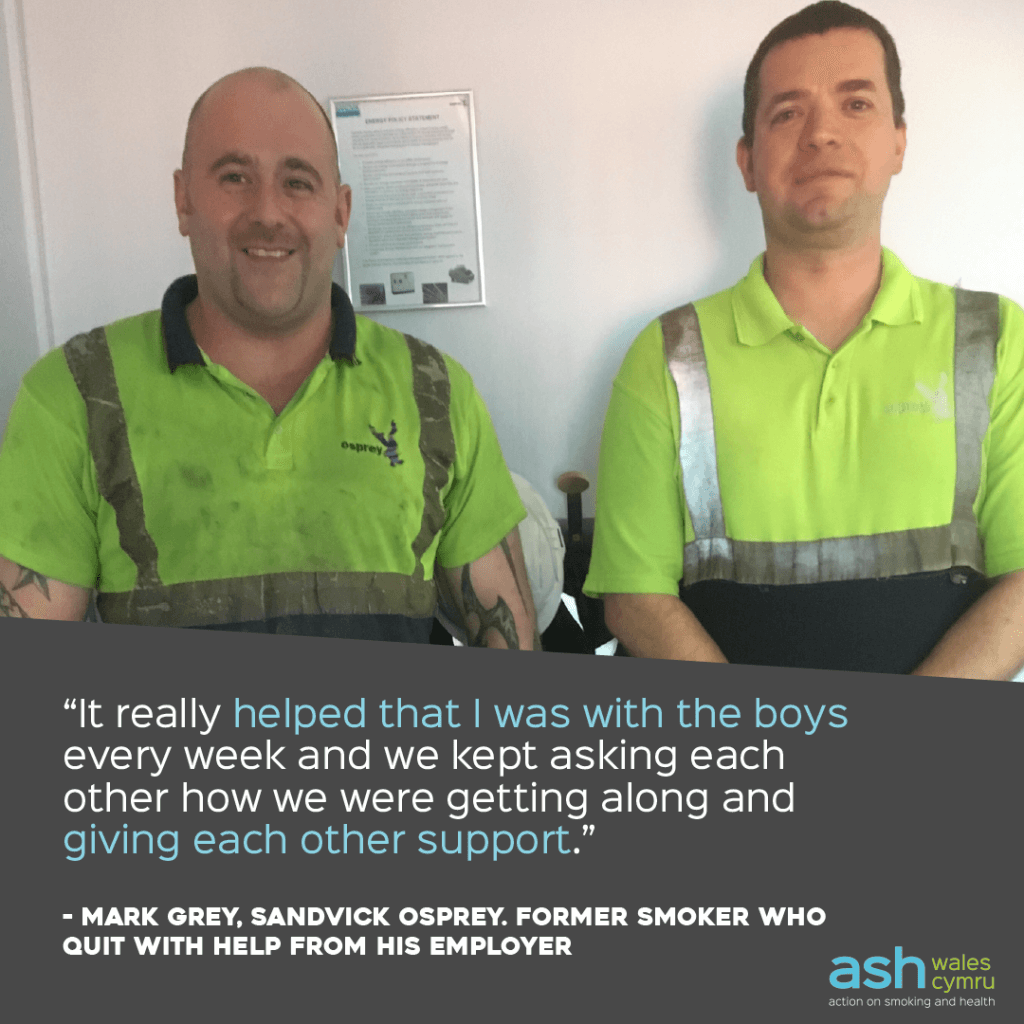
Quit Smoking (Wales) is a non-judgemental space where members give each other support and encouragement and share their thoughts and feelings about the highs and lows of giving up smoking.

If you’re battling nicotine addiction and hope one day to give up, the experiences of others in the group could provide just the inspiration and motivation you need. Indeed you may find it easier to quit if you have a support network you can rely on.

And if you’ve just embarked on your quit attempt, you can meet and chat to others on the same journey. Perhaps you want to compare notes on different forms of nicotine replacement therapy or simply sound off about cravings.

Meanwhile, former smokers are welcome to tell the stories of how they gave up, revealing the quit smoking method that worked for them. They may also be seeking motivation to stay on track if the urge to smoke strikes.

If you would like to become a member of the group visit https://www.facebook.com/groups/733935793649137/.

BBC report to reveal scale of illegal tobacco problem in Wales

THE scale of the illegal tobacco market in Wales is set to be highlighted by BBC Wales in a special report tonight.

ASH Wales CEO Suzanne Cass will appear in the report, in which Trading Standards officers will call for the establishment of a government task force dedicating to tackling the problem.

Currently illegal tobacco makes up 15% of all tobacco sales in Wales, the highest level in the UK, with 45% of all smokers in Wales having been offered the chance to buy it. Since 2013 around 150,000 illegal tobacco products have been seized in Wales.

It is sold at pocket money prices, with a pack of 20 illegal cigarettes costing just £4, making it easily accessible to those who would not otherwise be able to afford it.

However, the impact of illegal tobacco market in Wales, goes beyond its effect on smoking prevalence.

The BBC Wales report will also focus on its links to other forms of serious organised crime and the way the growing illegal tobacco market in Wales is bringing those behind such crimes into our communities.

ASH Wales has played a major part in raising awareness of the impact of illegal tobacco in Wales and last year was commissioned by the Welsh Government’s Tobacco Control Strategic Board to design a programme to tackle the issue.

ASH Wales CEO, Suzanne Cass, said: “There is an urgent need to establish a dedicated government department to tackle the growing illegal tobacco trade in Wales. A co-ordinated approach is also needed between local authorities, the police and Welsh Government to stamp out what is becoming a wider problem.

“Illegal tobacco is easily available in our most deprived communities where smoking prevalence is highest and plays a big part in perpetuating the stark health inequalities that exist across Wales. Not only does illegal tobacco undermine all key tobacco control measures but it is also helps to fund other forms of organised criminal activity in Wales, threatening community cohesion and putting lives in danger.”

In 2014 ASH Wales led the first pan-Wales research project to assess the scale of the illicit tobacco market in Wales, among its findings, were the fact that 59% of those who purchase illegal tobacco buy it at least once a month and 52% of purchases take place at a private address, while 45% were in a pub or club.  Among those who buy illegal tobacco 70% said it allows them to smoke when they can’t afford it.

Other key findings:

  • 59% of those who purchase illegal tobacco buy it at least once a month
  • 70% of buyers of illegal tobacco strongly agree that it allows them to smoke when they can’t afford it
  • 45% see it as an important issue that affects the local community
  • 26% of those surveyed said they would be likely to report its sale

Is smoking vegan?

VEGANISM is on the rise with the number of people in the UK switching to a plant-based diet having quadrupled in the past four years.

While some make the switch for purely dietary reasons for many veganism is an ethical choice based on concerns about animal welfare and the impact of meat production on the environment.

There is plenty of information out there about cutting meat, dairy, fish and poultry products out of your diet and embracing a vegan lifestyle free from products derived from or tested on animals – from cosmetics to clothing.

But what about if you’re a smoker? Are cigarettes a vegan product?

The essential ingredients?

The basic measure of whether a product is vegan is whether it contains any ingredients derived from animals or their by-products.

When it comes to cigarettes, that question is difficult to answer because the ingredients used to make them are often unregulated and non-transparent such as any additives or processing aids used in the production process.

What we do know is that Castoreum, a chemical found in the glands of beavers has be used previously in the production of tobacco cigarettes to give them a sweet flavour.

Castoreum cannot be harvested from a living beaver – the only way to obtain the chemical is to kill the animal.

As tobacco companies can be notoriously secretive about the ingredients they use, we do not know for sure whether castoreum continues to be used.

Given this level of uncertainty, cigarettes could present an ethical dilemma for vegan smokers.

Blue planet?

Concerns over the environmental impact of meat production drive many to adopt a vegan lifestyle.  But what about the huge impact the tobacco industry has on the environment? In 2014 alone 32.4million tonnes of green tobacco leaf were cultivated on four million hectares of land across 125 countries, producing 6.48 million tonnes of dry tobacco which was manufactured in almost 500 factories worldwide.

Significant waste and emissions are produced at every stage of the supply chain and globally the tobacco industry generates around 84 million tonnes of C02 equivalent.  Tobacco growing involves the use of pesticides, fertilizers and growth regulators and the tobacco crops deplete soil nutrients taking up more nitrogen, phosphorus and potassium than other major crops.

Once the cigarettes have been produced they continue to wreak havoc on the environment. Cigarette litter is the number one most littered item in the world.  Cigarette butts contain plastic and take up to 12 years to biodegrade.  Many find their way into the sea and waterways and are swallowed by animals, leading to poisoning, malnutrition and death due to the tar and chemicals they contain.

10 reasons why smoking is bad for the planet

Smoking and animal testing?

Given that animal welfare is one of the major reasons to adopt a vegan lifestyle, vegans should be made aware that most tobacco products are or have been tested on animals.

To give one example, according to the animal rights organisation Peta, “RJ Reynolds and Philip Morris have conducted tests in recent years in which animals were forced to inhale cigarette smoke, eat tobacco and have cigarette tar smeared onto their bare skin”.

It is important to bear in mind that RJ Reynolds is the parent company of American Spirit which claims to produce vegan tobacco.